

We recently heard from an executive at a global manufacturing company who came to us after spending a weekend reading a book on customer journey design. He’d taken ten pages of notes and reflected on his organization’s own customer experience.
To him, the most immediate gap was in how they onboarded new customers. He told us that it involved 20-30 emails being sent back and forth, sometimes misdirected and needing to be re-routed, and it represented a huge amount of waste. In his words, “that’s an enormous opportunity to make a first-grade impression that gets lost and a process that certainly leaves a lot to be desired.”
What he described mirrors the experience most B2B customers experience during client onboarding today. Their journey is procedural and a little robotic, and while it can get the job done, it lacks the intentionality that customers experience elsewhere in the lifecycle.
What’s encouraging, though, is that more companies (like this exec’s) are being more thoughtful about how they structure their customer onboarding process. They’re thinking about it like product designers. To them, onboarding is as much a part of the product as the product itself.
Let’s drill into what distinguishes a well-designed onboarding process from one that isn’t and how to design one in practice.
An Onboarding Checklist vs. an Onboarding Experience
Many onboarding processes weren’t purpose-built so much as they were assembled over time. What they often turn into is a checklist that’s a little bit frankenstein’d between tasks that were added along the way. It technically covers the bases, but it’s more geared toward the internal team’s operational comfort rather than the customer’s experience of going through it. Most customers, if they’re being honest, can feel the difference.
That’s worth sitting with for a moment, because the downstream effects are real. A poor onboarding experience is one of the leading drivers of first-year churn, even if the product is virtually perfect for the customer’s needs. That risk stems from the customer losing confidence in both the product and the company, and that confidence is extremely difficult to win back.
Ultimately, that’s a design failure, and the reason design failures are so costly is that you can’t overcome them by telling your team to execute harder. You can have the most diligent project managers in the industry and still lose customers in the first 90 days if the experience they’re delivering was never intentionally built in the first place.
So what does a well-designed process look like? It’s an intentional experience that’s an extension of your product. And like any product, how it’s designed determines how it performs.
We’ve had the pleasure of seeing some incredible examples of well-designed onboarding experiences from our customers. Take Hyphen Solutions, for example.
Hyphen builds software for the residential construction industry, and their product suite is broad (scheduling, purchasing, accounting, and payments), which means that their implementation org has grown into something equally complex. Each product line had its own team running its own process, and customers purchasing multiple products were effectively being onboarded several times over by several different groups.
Internally, Jenifer Owen, their Director of Implementations, described it plainly: “Everybody ran off their own individual spreadsheets that they created in a siloed environment. There was a lot of gray area.”
From the customer’s side, that gray area had a texture to it. They didn’t always know who to contact, they were juggling separate timelines across separate teams, and what should have felt like one unified partnership felt more like working with three distinct vendors who happened to share a logo.
What Hyphen did—and what distinguishes them as a genuinely well-designed onboarding operation—is that they treated that problem as a product problem. They consolidated their onboarding experience across all product lines into a single, structured process with clear milestones, defined ownership, and real-time visibility for everyone involved.
The results were significant: for one product line alone, they reduced average go-live time from 184 days to 86 days, a 53% improvement. But perhaps more telling than the time savings is what Aaron Gray, their SVP of Customer Experience, said about what the process itself signals to prospective customers: “Just by showing GUIDEcx, they know we have a well-thought-out, documented process. It gives them peace of mind.”
That last point is worth underscoring. A well-designed onboarding experience performs better, and it can even sell better. It tells a customer, before they’ve gone live on a single feature, that the company they chose knows how to take care of them.
What Separates the Companies That Have Figured This Out
- They build for where their customers are, not where it’s convenient for them.
A common mistake in structuring a customer onboarding process is designing it around what’s easy to track internally vs. what’s easy for the customer to engage with. Always start this process by asking, “where does this customer actually spend their time, and when?”
When is just as important as where because of a surprising finding we uncovered when reviewing GUIDEcx data. Around 80% of onboarding tasks on GUIDEcx are completed outside of standard working hours, which means customers are doing this work in the margins of their day. That’s why we’ve built unique ways in our customer onboarding software in which customers can engage and complete what’s required of them.
- They care deeply about creating transparency during onboarding.
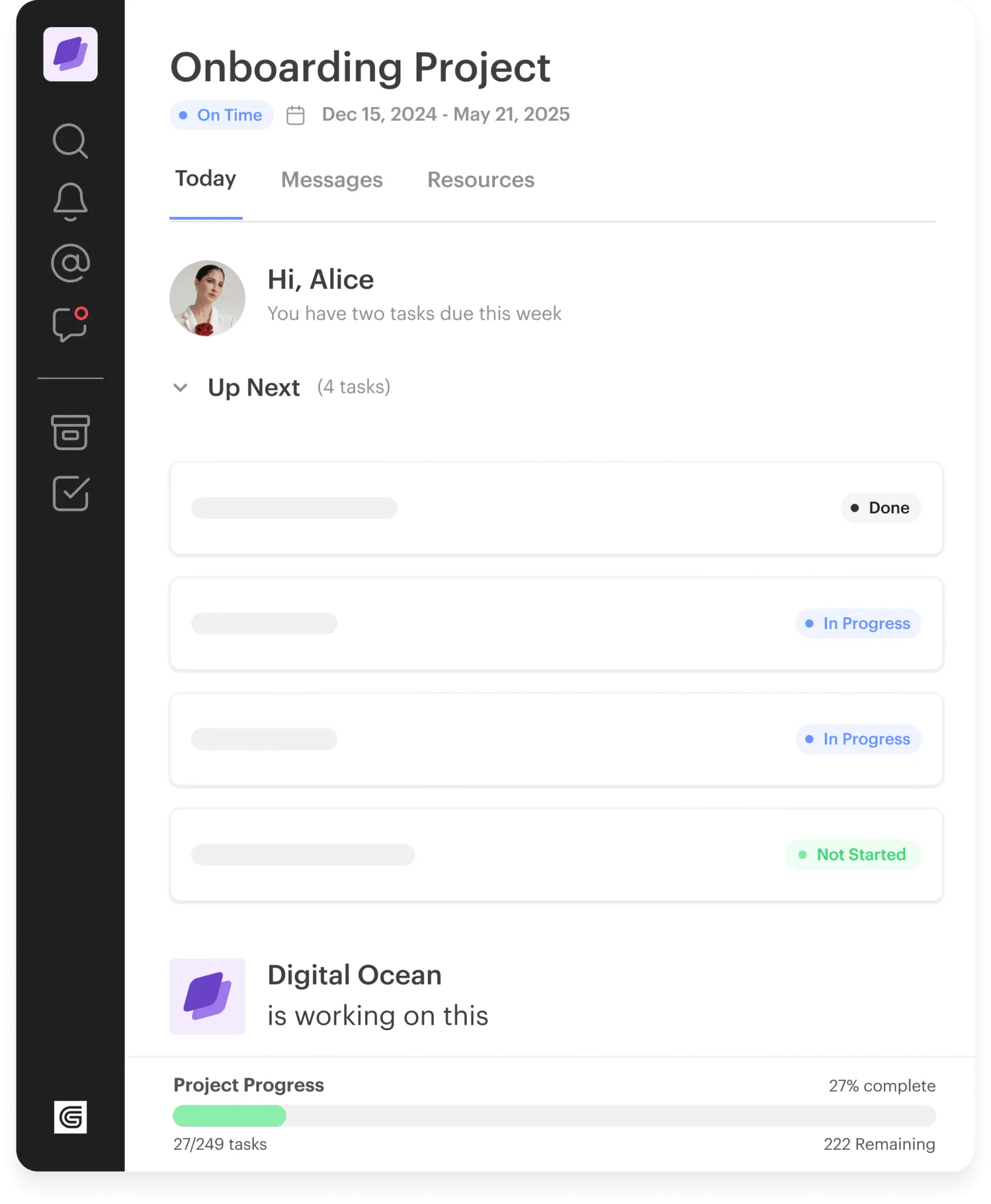
The most underappreciated driver of early churn is information asymmetry. Your customers should be just as informed about how their onboarding is progressing as you are. Unfortunately, teams miss out on providing this key component of a healthy customer relationship by creating onboarding experiences that aren’t customer-facing.
The fix is making transparency structural rather than dependent on someone’s initiative. That means every stakeholder — internal and external — has a clear, current picture of what’s been completed, what’s coming up, who owns what, and whether the project is on track. In GUIDEcx, we enable that transparency by providing a dedicated workspace just for customers where they can view what they’re required to complete and the status of their project. See our take to the right.
- They treat onboarding as an innately human experience and design their process to protect that.
There’s a tempting version of onboarding optimization where the goal is to automate as much as possible until the process runs itself. And there’s real value in that direction. Automating routine, deterministic work with AI is one of the highest-leverage things an implementation team can do.
But you need to draw a hard line of where automation ends and human judgment begins. The best teams we’ve seen automate the routine work in their onboarding process (follow-ups, project creation, etc.) so their people have the capacity to do the irreplaceable things, like noticing when a customer is disengaging, having the conversation that resets expectations before they calcify into resentment, and delivering the kind of attentiveness that makes a customer feel like they made the right call. That’s not something a workflow can do. Technology should create the conditions for that kind of relationship. It shouldn’t try to replace it.
How Customer Onboarding can Become a Competitive Advantage
Good onboarding design can extend beyond operational efficiency. Companies that design onboarding as a product can build a structural retention advantage, one that’s very hard to replicate quickly once it’s in place.
When your onboarding experience looks and feels like an extension of your product—white-labeled, persona-aware, integrated with your other systems, and efficient where it’s meant to be—it signals organizational maturity to the buyer. That distinction follows the relationship forward.
That’s the opportunity sitting in front of most B2B leaders right now. Your customers are already expecting a designed experience. The question is whether your onboarding is built to deliver one.
Want to see what a product-level onboarding experience looks like in practice?
Book a demo — we’ll show you how GUIDEcx does it.

- How to Use MCP with the GUIDEcx API for AI-Powered Customer Onboarding – September 4, 2026
- How to Reduce Manual Work in Customer Onboarding – August 31, 2026
- Introducing the State of Customer Onboarding in 2026: All New Report – August 17, 2026