



In 2008, Domino’s launched its Pizza Tracker, the first of its kind in the pizza chain market. Customers could see exactly where their order was (even when it was in the oven) and when it would show up at their door.
Domino’s reasoning was simple: they wanted customers to be able to plan around their pizza delivery. After tracking $2B in orders, the transparency Domino’s pioneered for its customers has changed customer expectations forever.
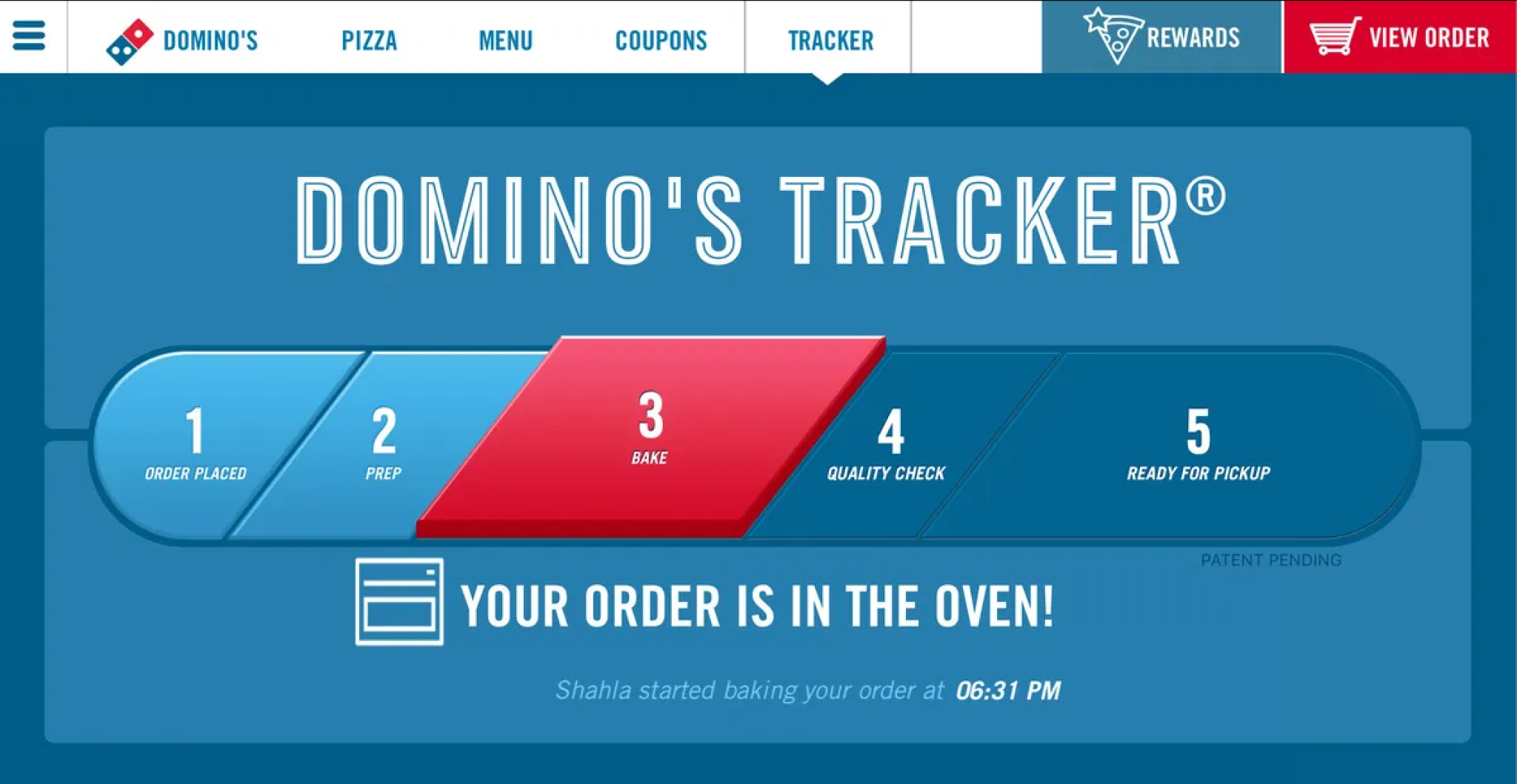
So now, it’s a ubiquitous concept in B2C. You know where your Uber is before it pulls up. Your Amazon package has a live map showing how many stops it will take before your delivery arrives. DoorDash sends a notification when the driver picks up your order.
It makes sense for B2C companies to iterate on this standard, and they have for over a decade. They understand that uncertainty is its own form of bad experience.
So why didn’t B2B get the memo? The B2B SaaS market is particularly behind in providing transparency for its customers into how long their implementation will take, where they’re at in the process, and what’s causing delays.
It’s paradoxical because in B2B, the stakes are generally much higher. B2B customer onboarding carries the weight of 5- or 6-figure contract sizes, multiple stakeholders, and real capital vs. orders of much smaller dollar amounts in B2C transactions.
Bottom line—this gap is hurting B2B organizations, and the data backs it up: 100% (seriously, 100%) of the onboarding teams we talked to last year mentioned they struggled to provide transparency to their customers during onboarding.
In this article, we’ll break down why this gap is particularly damaging for B2B onboarding teams and how they can fix it.
Why Onboarding Teams Struggle to Provide Transparency to their Customers
Most B2B onboarding is designed around the vendor’s internal workflow, not the customer’s visibility. The information to create transparency usually exists: which tasks are blocked, which milestones are coming up, and which customer stakeholders haven’t completed their dependencies. The problem is that Your CSM knows it and your project manager knows it, but it’s rarely surfaced in a way that’s visible to every stakeholder in real time.
That’s partly a tooling problem. Onboarding teams have historically been handed whatever was available — spreadsheets, generic project management software, email threads — rather than purpose-built customer onboarding platforms capable of producing that shared, real-time view.
But tooling is only part of the story. The deeper issue is organizational. Onboarding sits in an awkward position inside most B2B companies, and it’s deeply under-invested in. It’s not Sales, it’s not Customer Success, and it rarely has the budget or executive attention of either. The teams running implementations are often operating without dedicated reporting infrastructure, without a clear way to surface project health to leadership, and without any mechanism to give customers a window into what’s actually happening. They’re expected to deliver complex, multi-stakeholder projects while working around tooling gaps that their counterparts in Sales and CS don’t have to think about.
The consequence is that transparency becomes a heavily manual effort. CSMs need to send custom status updates. Project managers need to pull data from disconnected sources and stitch it together before a call. Then, management only gets a version of the truth that’s already hours old by the time it reaches them. And the customer gets whatever the team had time to prepare, which is rarely the real-time picture they actually need to stay confident in the process.
How Visibility Gaps Erode Customer Confidence
When a customer can’t see where their onboarding stands, the relationship starts deteriorating before the product ever gets a chance to prove itself. They’re also less accountable to complete what’s required of them.
The confidence erosion is usually incremental more than it is dramatic. Every unanswered question about project status is a small signal that compounds into a larger conclusion. By the time a customer raises a formal concern, that conclusion has usually been forming for weeks.
That pattern follows the relationship forward. A customer who spent months in an opaque implementation doesn’t arrive at their first QBR with goodwill to spend. Their bar for escalation is lower, and their risk of churn is higher.
To get the full picture, consider how a highly visible onboarding process can inversely create confidence. Think about the pizza tracker. When you order from Domino’s, you’re not calling the store to ask where your order is because you can see it moving in real time. The same dynamic applies to B2B. When customers can see the progress of their onboard project, who’s responsible for doing what, and what’s required of them next, they’re more engaged in the process. They can even be more forgiving; knowing a delay is coming and that it’s being handled is much better than not.
How to Give Onboarding Transparency to B2B Customers
If the problem is tooling and organizational in nature, then the solution lies in software that enables the reporting and the structure to give your team and customers the visibility they need.
In practice, our take is that you have to make onboarding a customer-facing experience. That means bringing it out of fragmented systems and into a shared environment where progress is visible by default. Workflows are structured so projects don’t get reinvented, expectations are clear, and everyone involved can see where things stand and what needs to happen next. Follow-up is automated and becomes part of the process itself, not something dependent on individual effort.
That’s the B2B version of the pizza tracker. And the companies building it now are going to have a structural retention advantage over the ones waiting for the problem to get loud enough to force a response.
If you want to see what this looks like in practice, reach out — we’ll show you how GUIDEcx does it.

- How to Onboard a Customer – April 9, 2026
- Our CTO, Alex Nelson, on Coffee With Calyptus – March 31, 2026
- Why You Can’t Vibe Code a Customer Onboarding Solution – March 31, 2026