


Did you know that 62% of onboarding professionals say their company has lost at least one customer early because of a poor onboarding experience?
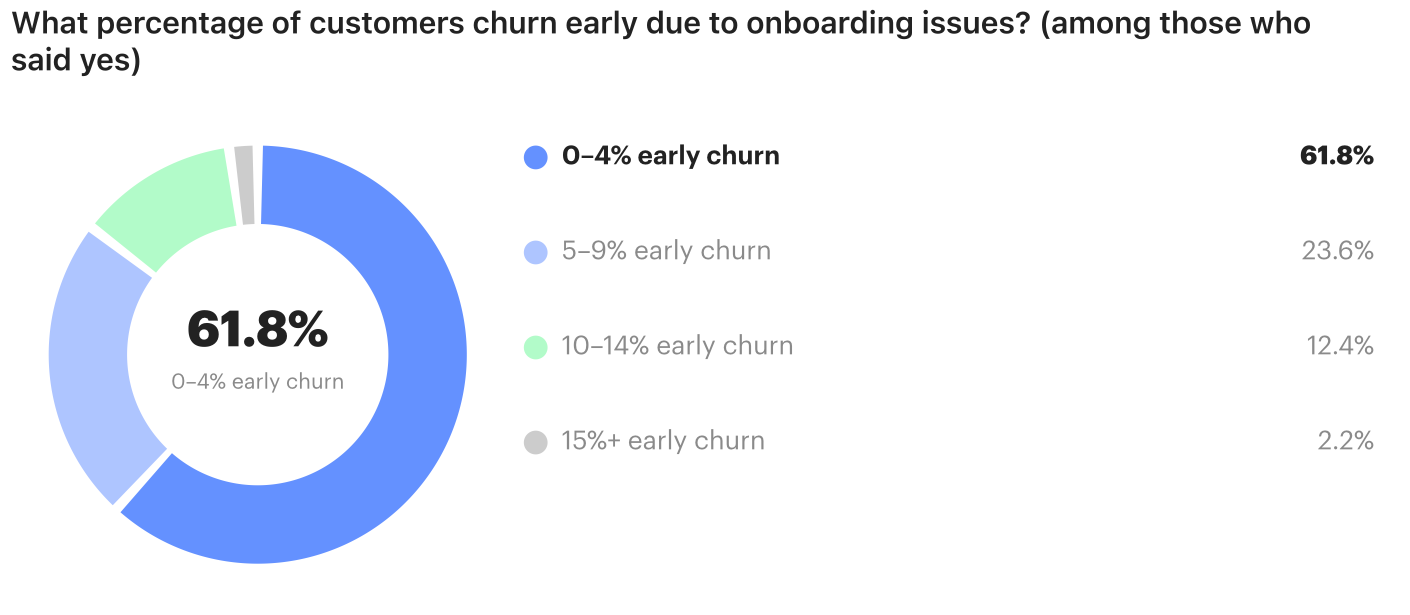
That’s one of the findings from our survey of 200 customer onboarding professionals for our 2026 State of Customer Onboarding Report. And when we looked more closely at the companies experiencing early churn, the numbers became even more concerning:
- Nearly 40% of companies lose 5% or more of their new customers early.
- 15% lose more than 10% of their new customers early.
We call this inception churn. When you lose a customer during onboarding, before they’ve had the opportunity to realize the full value of the product or service they purchased.
It’s an especially painful form of customer churn because it happens at the point when customer enthusiasm should be at its highest. The contract is signed, expectations are high, and your customer is ready to solve the problem that brought them to you in the first place.
Instead, something breaks down between the sale and value realization.
The good news? Inception churn usually isn’t a product problem. More often, it’s a process problem. Manual administrative work, unclear expectations, poor handoffs, invisible delays, and communication gaps introduce friction into what should be one of the most exciting stages of the customer relationship.
This means onboarding teams have a significant opportunity to influence customer retention and revenue long before a traditional churn signal ever appears.
Why Customers Churn During Onboarding
Customer onboarding teams work incredibly hard to deliver successful implementations. But even strong teams can be held back by broken processes. Our research points to three areas where that friction commonly appears.
1. Broken Sales-to-Onboarding Handoffs
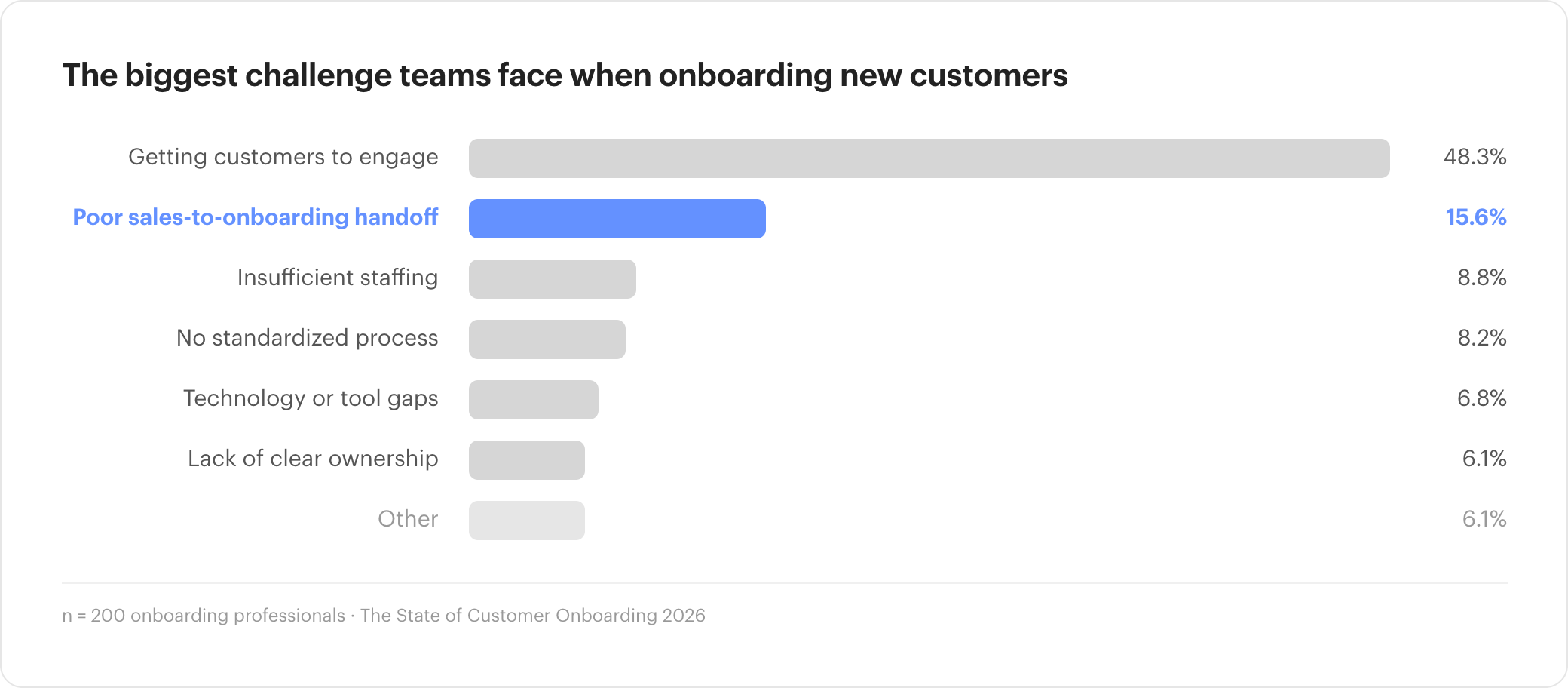
According to our state of onboarding report, 16% of teams say a poor sales-to-onboarding handoff is their single biggest onboarding challenge.
Think about what happens from the customer’s perspective.
During the sales process, they discuss their goals, challenges, timeline, use cases, stakeholders, and desired outcomes. By the time they reach kickoff, they expect the onboarding team to understand why they bought. But that context doesn’t always make it through the handoff.
The customer may have to repeat information they already provided. The implementation team may discover a timeline or requirement that was never communicated. Or the customer may arrive expecting an outcome that isn’t aligned with the actual onboarding plan.
Each disconnect creates an expectation gap, and expectation gaps erode trust. A strong handoff is the bridge between the experience your sales team promised and the experience your onboarding team delivers.
2. The Cognitive and Time Burden
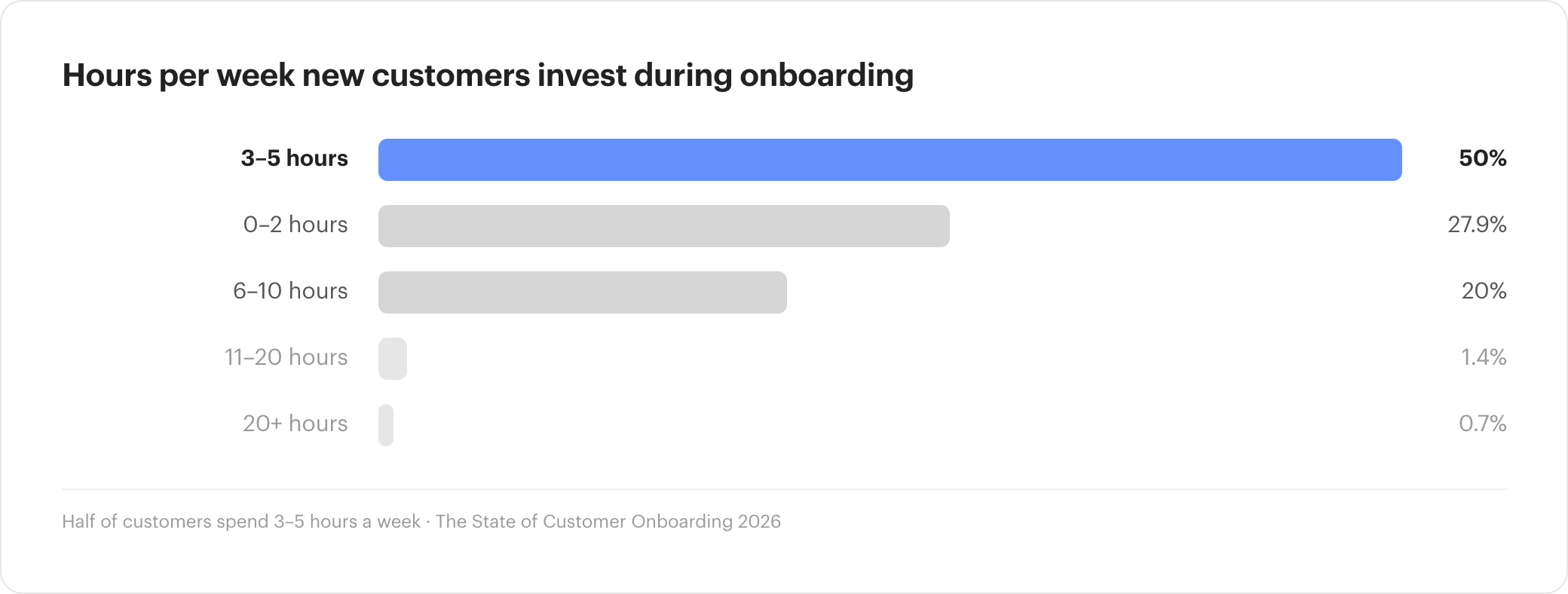
Our research found that 70% of onboarding processes demand three or more hours per week from the customer, while 80% of customer onboarding tasks are completed outside normal working hours.
That’s a lot to ask from a customer who probably has a full-time job that doesn’t include implementing your software.
Customers buy products and services because they want to solve a problem, save time, generate revenue, reduce risk, or make their work easier. But before they can reach that value, onboarding often asks them to complete forms, gather data, coordinate stakeholders, attend meetings, respond to emails, and track down internal approvals.
Every additional task creates cognitive load. If those tasks are scattered across emails, spreadsheets, project management tools, and internal systems, the burden gets even heavier. Eventually, customers stop thinking, “I’m excited to get this live,” and start thinking, “I don’t have time for this right now.” This is when deadlines slip, engagement falls, and an otherwise healthy customer can quietly become an at-risk account.
However, your goal shouldn’t necessarily be to eliminate customer effort. Some implementations require meaningful participation. Your goal is to make every required action clear, purposeful, and easy to complete.
3. Lack of Visibility
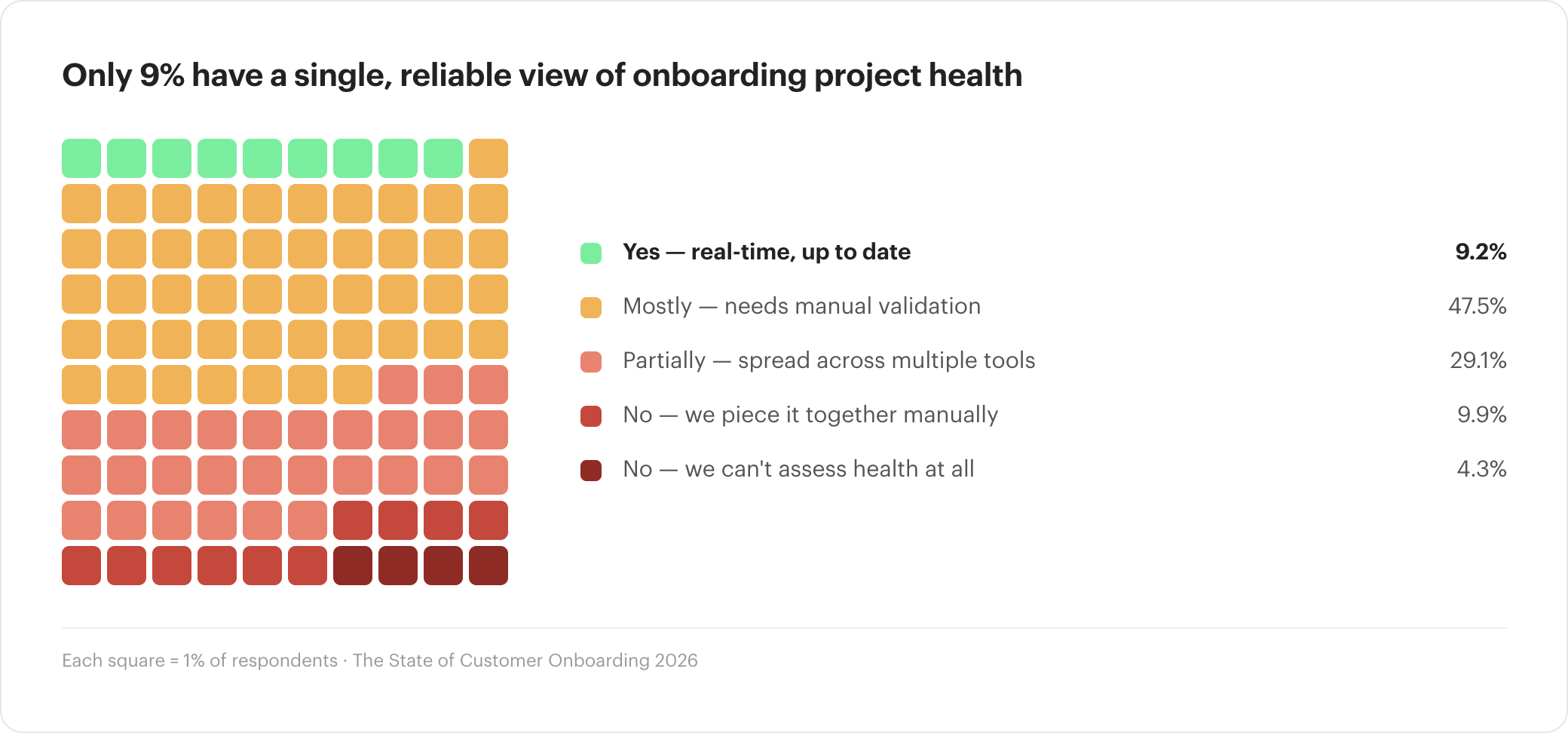
Our report found that 60% of onboarding professionals say their customers don’t have a real-time view into onboarding progress. And only 9% of teams have a reliable view of onboarding health across their portfolio internally, so it makes sense that customers don’t know where their onboarding project is at.
Imagine ordering something for a special event, and the package is delayed. If you didn’t have updated information on when to expect the package, at what point would you cancel the order and find another solution?
The delay itself is frustrating, but the uncertainty makes it worse. You don’t know if you’ll get what you need in time, so you change plans.
Customer onboarding can create the same feeling. When customers can’t see progress, understand what’s blocking the project, or know what needs to happen next, normal implementation delays can start to feel like something is wrong. Silence creates room for uncertainty.
Visibility does the opposite. Even when a project isn’t moving as quickly as everyone hoped, a customer who can see where the project stands, what’s causing the delay, who’s responsible for the next action, and what happens next has context. That context builds trust.
If you are interested in learning more about onboarding visibility, come back in a few weeks for another blog post in this series diving deeper into this topic!
The True Cost of Inception Churn
Losing a customer during onboarding is more than lost future subscription revenue. By the time onboarding begins, your company has already invested significant resources in acquiring and serving that customer. There are sales and marketing costs associated with winning the deal. Then there are implementation costs: kickoff calls, project planning, technical resources, onboarding specialists, customer communications, configuration, integrations, training, and more. When a customer churns before go-live, much of that investment is never recovered.
Consider a simplified example:
Imagine a company signs 1,000 new customers per year at an average first-year contract value of $20,000.
If 5% churn during onboarding, that’s 50 customers.
50 customers × $20,000 = $1 million in first-year contract value at risk.
And that’s before accounting for the internal cost of acquiring and onboarding those customers or the expansion and renewal revenue they might have generated later. This is why inception churn deserves attention beyond the onboarding organization.
Reducing this churn can influence revenue retention, improve the return on customer acquisition spend, protect implementation capacity, and give more customers the opportunity to reach value.
Why More AI in Onboarding Isn’t Enough
AI is quickly becoming part of the onboarding technology conversation. In our research, 46% of teams say AI is a priority, even though many organizations are still in the experimentation stage.
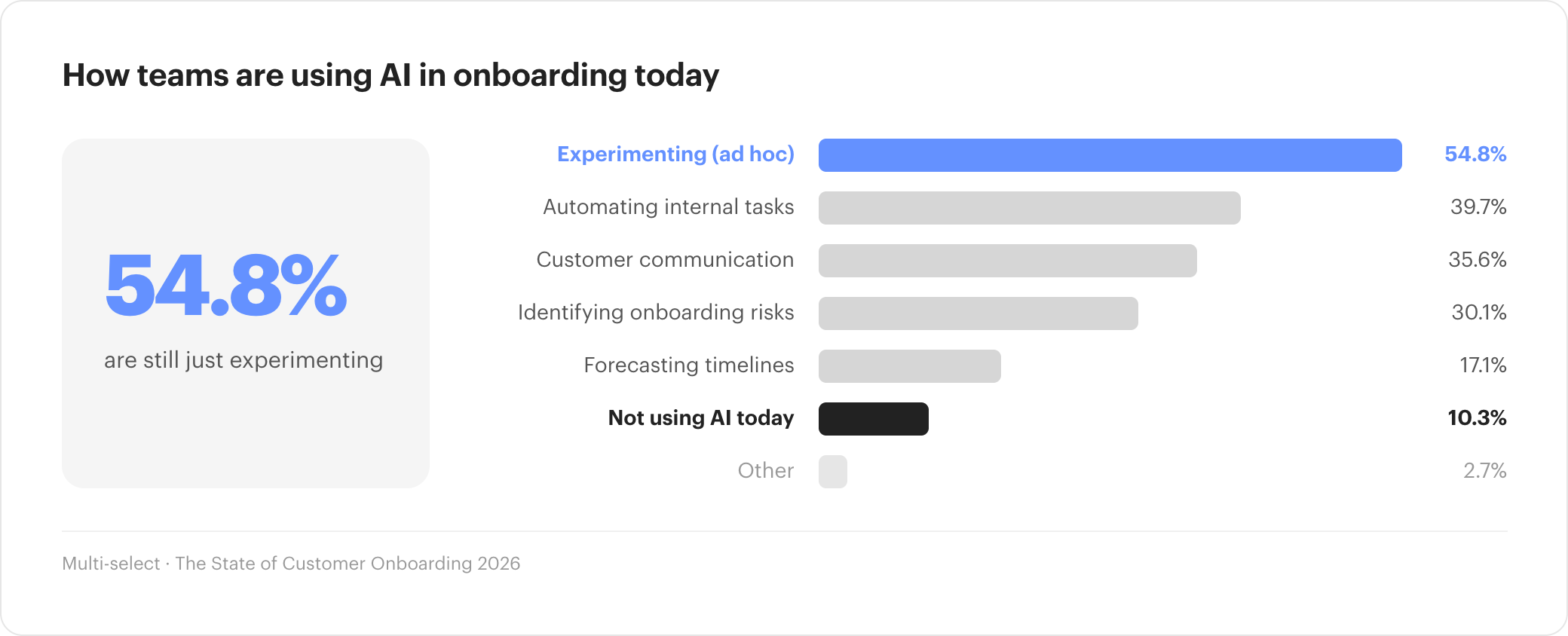
That creates an important question: Where should AI actually be used in onboarding?
It’s tempting to apply AI everywhere that it can be applied, from automating emails, generating project plans, responding to customers, summarizing, creating tasks, and updating statuses, and more. But automation alone doesn’t automatically create a better onboarding experience.
If your handoff process is broken, automating it simply moves incomplete information faster. If your project structure is confusing, generating more tasks doesn’t make it clearer. If your customers can’t see what’s happening, an AI-generated status summary doesn’t necessarily solve the underlying visibility problem.
Before asking, Where can we add AI?, onboarding leaders should ask, Where is friction preventing customers or our team from moving forward? That’s where AI becomes powerful.
AI can help identify risk across a large portfolio, summarize complex projects, surface stalled tasks, reduce repetitive administrative work, and help teams determine where human attention is needed most.
The best customer onboarding experiences aren’t the ones that are 100% AI. Think about it, we’ve all used AI chatbots that don’t have the answer we need and can’t get us in contact with someone who actually does.
The goal should be an onboarding experience where AI handles more of the work that doesn’t require a human, giving your team more time for the work that does. Building trust, solving complex problems, aligning stakeholders, and guiding customers toward value.
A useful first step is to evaluate the health of your current onboarding process and identify where friction, repetitive work, and blind spots exist.
Take the GUIDEcx Onboarding Health Assessment →
How to Prevent Early Customer Churn
Inception churn isn’t inevitable. While every onboarding motion is different, teams can address many of its underlying causes by focusing on customer visibility, proactive risk management, and stronger handoffs.
Step 1: Formalize the Sales-to-Onboarding Handoff
The onboarding experience begins before kickoff. Creating a standardized handoff process ensures critical context moves from sales to onboarding every time. At minimum, your handoff should capture:
- The customer’s primary goals and desired outcomes
- Key stakeholders and decision-makers
- Target timelines and important deadlines
- Relevant technical requirements
- Commitments or expectations established during the sales process
- Known risks or concerns
- The customer’s definition of a successful implementation
Whenever possible, make this information part of the onboarding workflow rather than another document someone has to remember to find. And don’t treat the handoff as complete just because information moved from one system to another. A successful handoff means the onboarding team understands the customer’s desired outcomes, and the customer experiences continuity between what they were sold and what happens next.
Step 2: Create Shared Internal and External Visibility
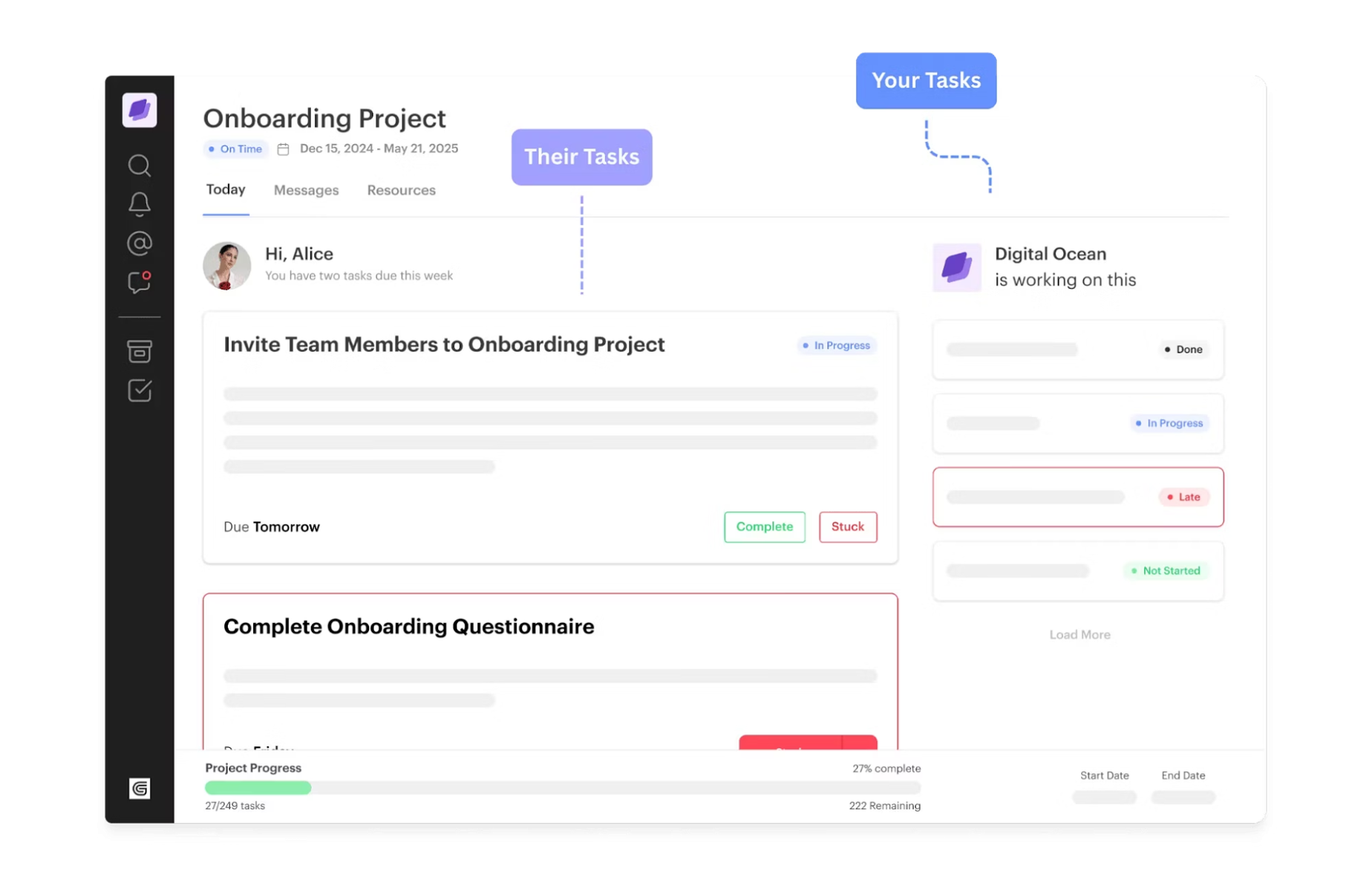
If onboarding lives across spreadsheets, inboxes, Slack messages, and internal project management tools, nobody has the full picture. Your internal team may understand what’s happening, while the customer doesn’t. Or the customer-facing onboarding manager may know a project is at risk while leadership doesn’t see the problem until it’s too late.
Create a shared source of truth where everyone involved in onboarding can quickly answer:
- Where are we in the process?
- What has been completed?
- What’s due next?
- Who owns each action?
- What is blocking progress?
- Has the expected go-live date changed?
This doesn’t mean every internal detail needs to be exposed to the customer. Internal teams and customers often need different views of the same project. But both should be working from the same underlying reality.
GUIDEcx gives internal teams and customers a shared onboarding workspace where project plans, tasks, communication, ownership, and progress can stay connected, without requiring customers to become experts in another project management tool.
Step 3: Move From Reactive Escalation to Proactive Risk Monitoring
Many onboarding teams discover risk too late. A project misses a milestone. Someone notices an email hasn’t been answered. The customer hasn’t attended the last two meetings. Suddenly, an account that appeared healthy is several weeks behind. This challenge becomes even greater for onboarding leaders managing dozens, or hundreds, of implementations at once.
You can’t manually inspect every task, email, milestone, and project every day. Instead, build systems that surface risk proactively. That might include monitoring for stalled tasks, overdue customer actions, shifting timelines, low engagement, missed milestones, or other indicators that an implementation is moving off track.
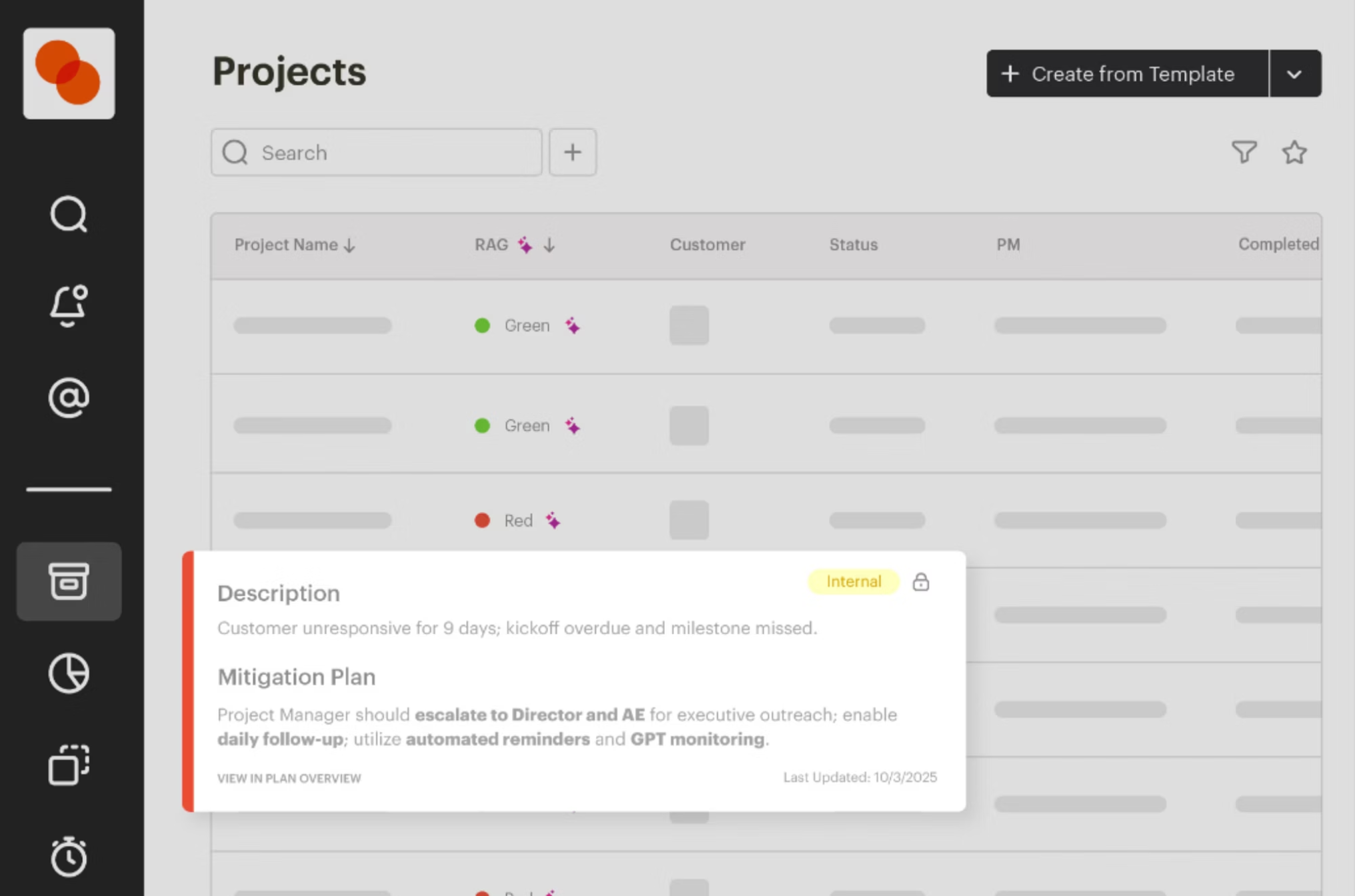
AI can make this much more scalable. Rather than asking onboarding leaders to hunt through every project looking for problems, AI-powered portfolio intelligence can help identify which projects need attention and why. AI shouldn’t manage customer relationships, but it can make sure your team knows where relationships need them.
GUIDEcx’s AI capabilities help teams surface portfolio-level risks and understand where intervention may be needed, so onboarding leaders can focus their attention on the customers who need it most.
Stop Churn Before It Starts
By the time a customer submits a cancellation request, the underlying problem may have been developing for weeks or months.
Inception churn asks onboarding leaders to look earlier. Where are expectations breaking down? Where are customers spending unnecessary time? Where are projects becoming invisible? And where could your team intervene sooner if they had better information?
The answers often aren’t about changing the product. They’re about creating an onboarding experience with less friction, greater visibility, clearer ownership, and earlier intervention.
Fix those problems, and onboarding becomes one of your company’s first and most important retention strategies.
Curious how your onboarding organization compares to 200 of your peers?
Download the 2026 State of Customer Onboarding Report →

- How to Build an Asynchronous Customer Onboarding Process Customers Actually Finish – October 22, 2026
- How to Manage Multiple Stakeholders During Customer Onboarding – September 22, 2026
- How to Track Project Health in Customer Onboarding – September 9, 2026