


Customer onboarding has always been a team effort. But for most B2B companies, the “team” is getting pretty crowded.
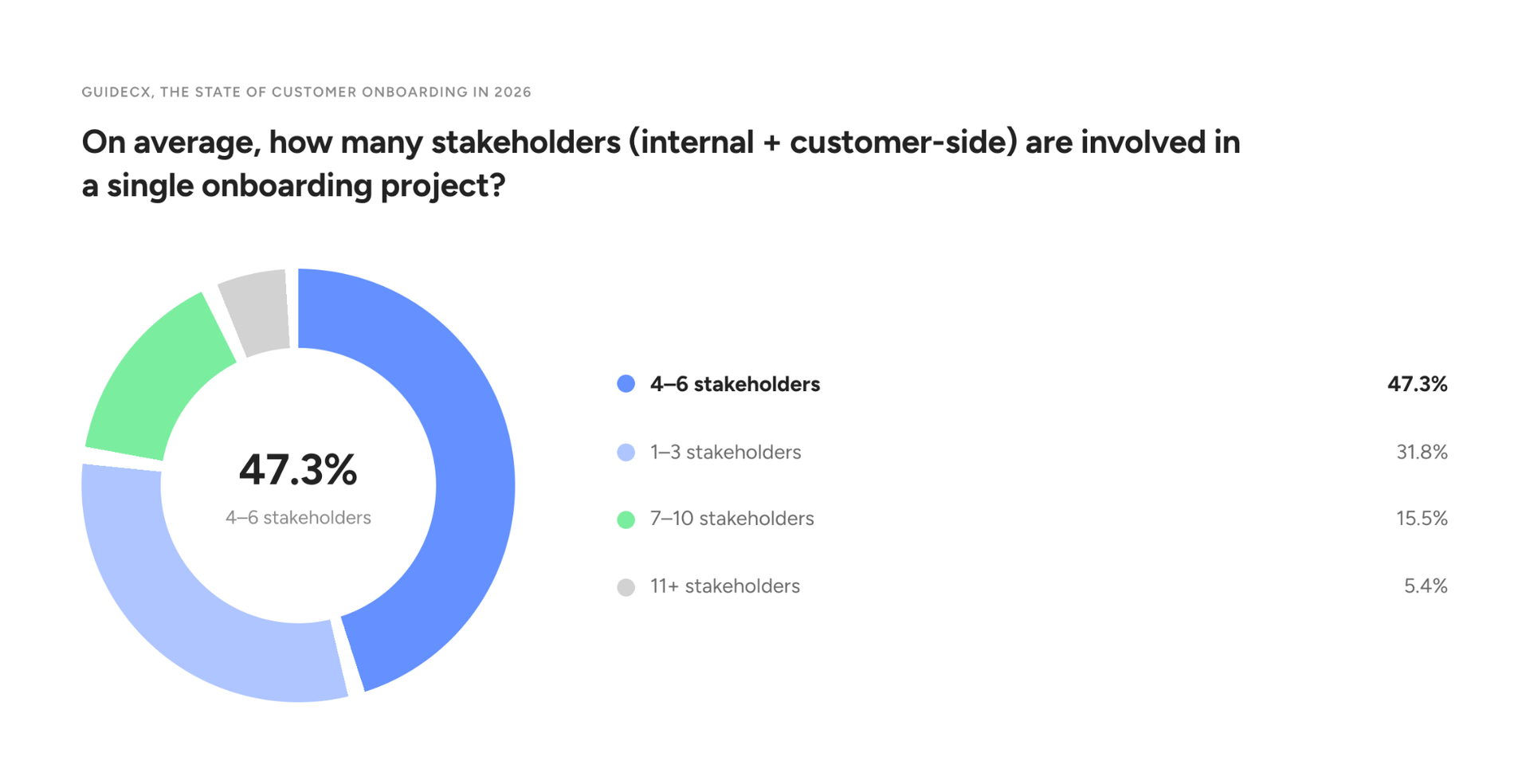
In our State of Customer Onboarding in 2026 research, we surveyed 200 professionals responsible for onboarding new customers across 18 industries. More than two-thirds (68%) said four or more internal and customer-side stakeholders are involved in the average onboarding project. Nearly 1 in 5 works with seven or more.
That might include an implementation manager, account executive, solutions engineer, customer success manager, executive sponsor, customer project lead, IT contact, administrator, and eventual end users, all trying to get the same customer live.
Having that many people involved isn’t necessarily the problem. Complex implementations often require a lot of stakeholders. But onboarding teams know that coordinating all of those people often becomes a project of its own.
Why does customer onboarding require so many stakeholders?
For most B2B companies, onboarding is no longer a simple matter of creating an account, providing training, and handing the customer off to Customer Success.
Products are more configurable, integrations need to be set up, and data has to move between systems. Different teams may need to approve decisions, complete tasks, or provide information before the next phase of onboarding can begin.
That makes onboarding inherently cross-functional. As we’ve written about before, a modern implementation is often an exercise in managing dependencies across people, systems, and timelines that no single person fully controls.
The most common onboarding project in our survey includes four to six stakeholders:
- 47.3% involve 4–6 stakeholders
- 15.5% involve 7–10
- 5.4% involve 11 or more
Together, 68.2% of onboarding teams are coordinating at least four people on a typical implementation. Each person brings another set of priorities, deadlines, responsibilities, and communication preferences into a project where one delayed approval or incomplete task can hold up everyone else.
Are more stakeholders bad for customer onboarding?
It would be easy to look at those numbers and conclude that onboarding teams should simply involve fewer people. The data suggests something more nuanced.
GUIDEcx project data cited in the report shows that projects with five or more customer users have an on-time completion rate of 91%, higher than projects with fewer participants.
Complex implementations often genuinely need expertise from multiple areas. The person who bought the product may not know how to configure an integration, while the project lead may lack authority to approve a process change. An executive sponsor, meanwhile, may be able to remove a blocker without knowing the technical details required to migrate data.
Rather than reducing participation, onboarding teams need to make it easier for each stakeholder to contribute at the right time. That becomes especially important when teams are already fighting for customers’ attention.
Why is stakeholder engagement so difficult during onboarding?
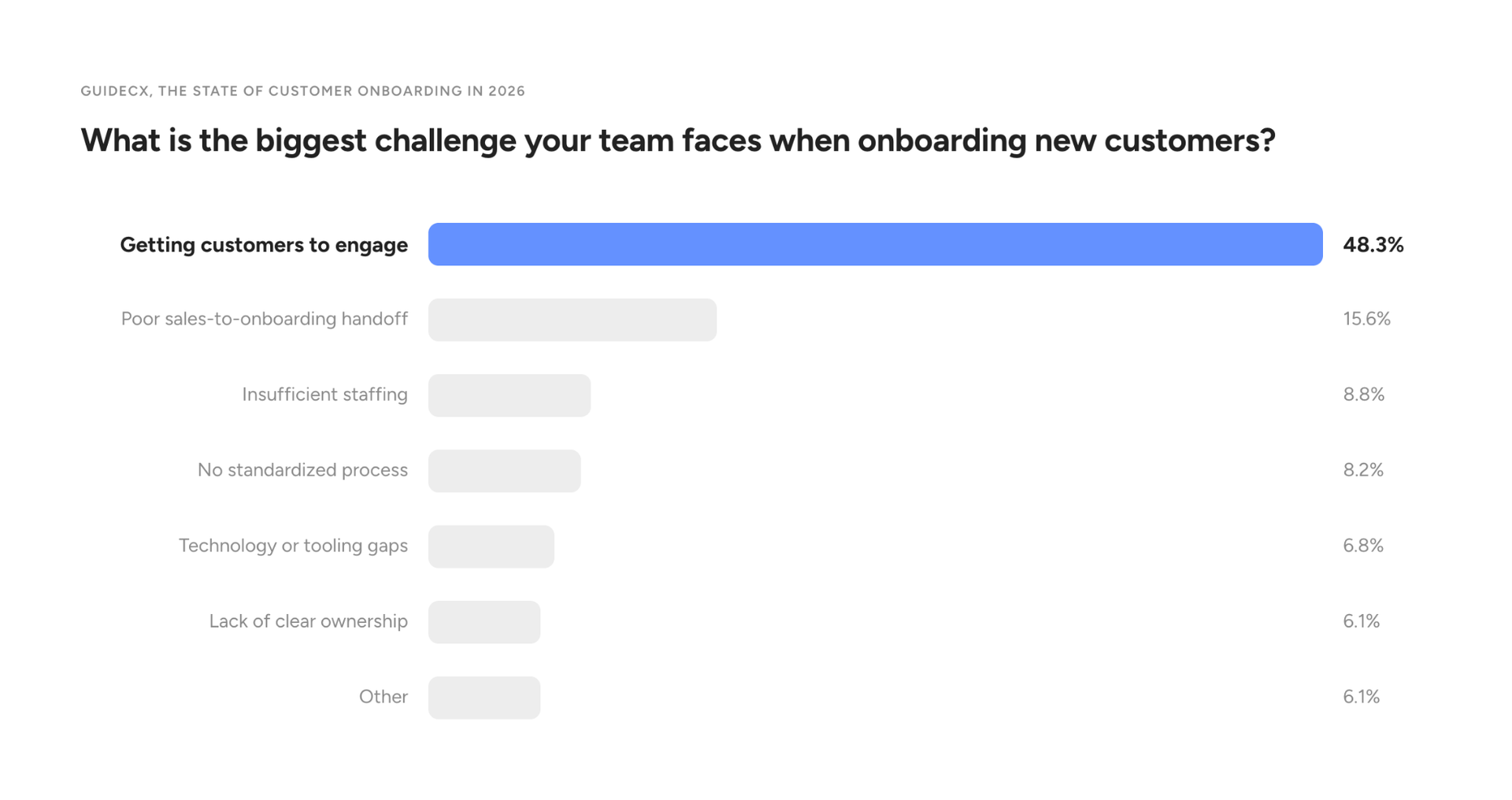
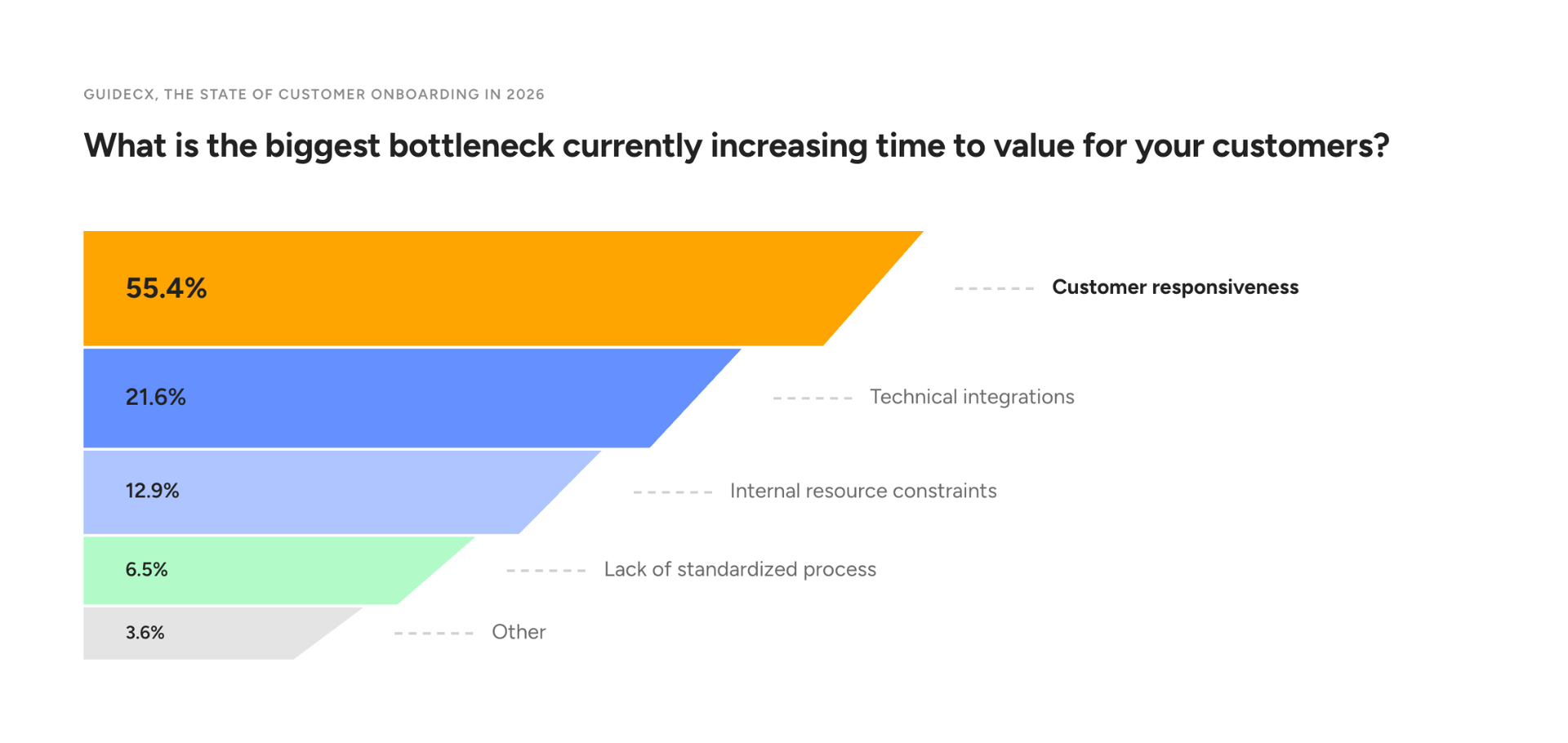
Nearly half of onboarding professionals (48.3%) said getting customers to engage is their team’s biggest challenge. And 55.4% said customer responsiveness is the biggest bottleneck increasing time-to-value.
More than 70% of respondents said their customers most commonly struggle either to stay engaged day to day or complete required tasks. At the same time, 70% said customers need to devote at least three hours per week to onboarding, including 20% who require six to ten hours.
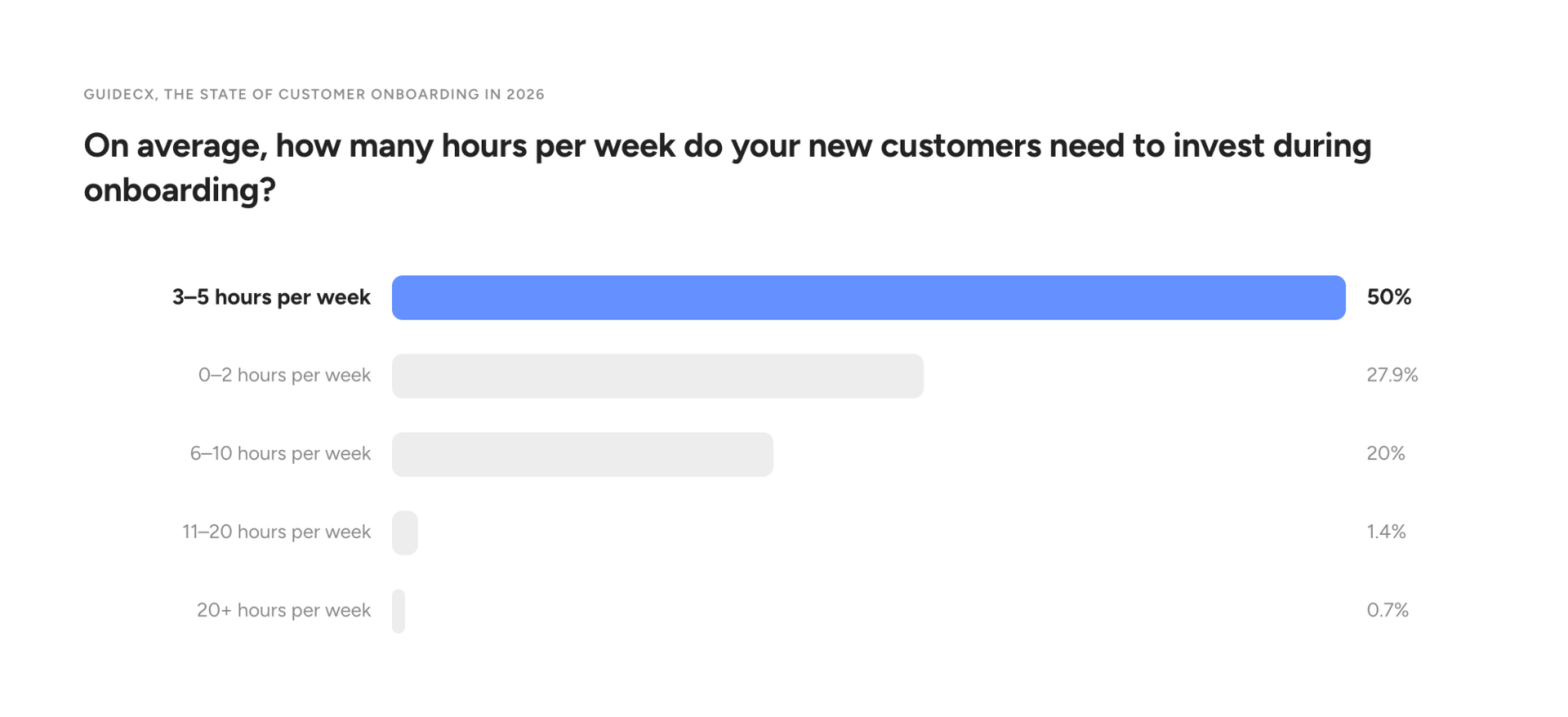
Spread that work across four, six, or ten people, and the coordination burden grows quickly. One stakeholder may be waiting on an approval while another needs to upload data. IT owns an integration task, the executive sponsor wants a high-level status update, and the implementation team needs to understand whether any of those dependencies will push the go-live date.
A project doesn’t need a catastrophic blocker to fall behind. One unanswered email, an unclear task owner, or a dependency that nobody realizes is overdue can be enough.
Effective stakeholder management therefore depends less on adding meetings and more on making ownership, progress, dependencies, and next steps obvious.
How do you manage multiple stakeholders during customer onboarding?
There are plenty of formal stakeholder-management frameworks, but onboarding teams usually need something more practical.
At a minimum, everyone involved should know what they’re responsible for, what needs their attention now, and where the overall project stands. A few operating habits make that much easier.
1. Identify every stakeholder before kickoff
Start by mapping the people who will actually influence the implementation, not just the primary customer contact.
Document who owns the project on both sides, who needs to complete work, who can approve decisions, who has technical responsibilities, and who needs visibility without being involved in day-to-day execution.
Stakeholder analysis typically starts by identifying both internal and external stakeholders and understanding their influence, interest, and role in the project. For onboarding teams, doing this before kickoff also exposes roles that could otherwise become late-stage blockers. Discovering three weeks into implementation that the customer’s security team needs to approve an integration rarely helps the timeline.
2. Make ownership painfully clear
“Customer to provide data” isn’t an owner. “Jordan to upload the customer file by Thursday” is.
When several stakeholders are involved, vague ownership creates follow-up work for the implementation manager and makes dependencies harder to manage. Every meaningful task should have a clear owner, deadline, and relationship to the rest of the implementation.
This is especially important for customer-side work. Your implementation manager shouldn’t have to remember which person at the customer owns every outstanding item and then manually chase each one. Assigning work directly to a named stakeholder turns a complicated implementation into a series of responsibilities that everyone can see and act on.
3. Give everyone one place to see what’s happening
Stakeholder coordination gets harder when every team has a different version of the project.
The implementation manager works from the project plan while the customer follows an email thread. Sales has notes in the CRM, leadership gets a weekly slide, and technical teams discuss blockers in Slack. Eventually, someone has to reconcile those sources into a single picture of where the implementation stands.
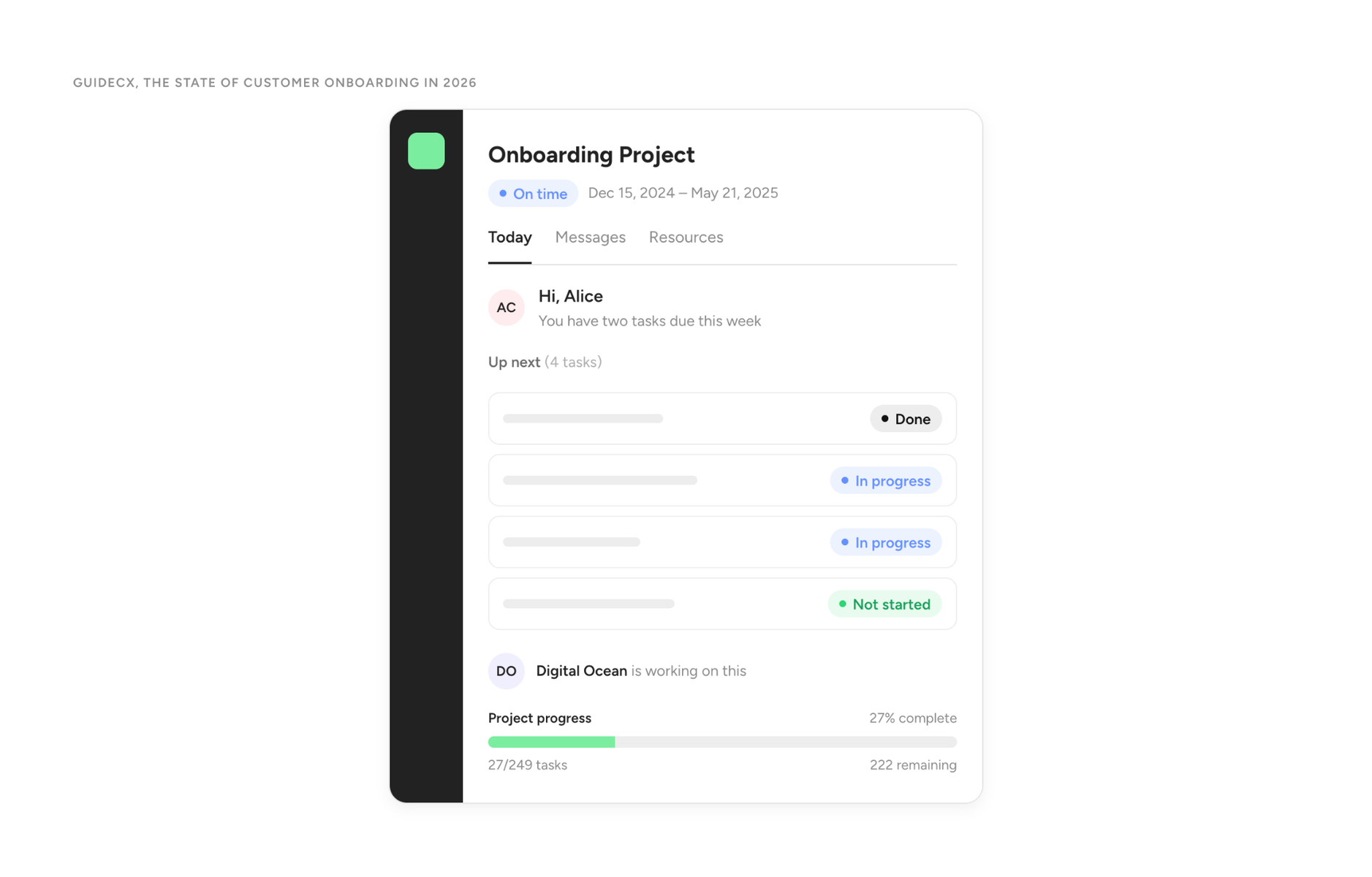
That manual reconciliation is already common. Nearly 60% of onboarding professionals surveyed said their customers don’t have a dedicated view of their onboarding progress, and 21% said updates have to be pushed to customers manually.
A shared workspace gives stakeholders a common reference point for tasks, milestones, deadlines, responsibilities, and progress. Project-management guidance similarly recommends maintaining a central place where stakeholders can access current project information rather than relying entirely on one-off updates.
For onboarding teams, the practical test is whether a customer can check project status without emailing their implementation manager for an update.
4. Don’t communicate with every stakeholder the same way
An executive sponsor and a technical administrator might be part of the same implementation, but they don’t need the same information.
The administrator may need detailed task instructions, due dates, and dependency information. An executive sponsor is more likely to need milestone progress, risks, outstanding decisions, and confidence that the project is still on track for go-live.
A useful stakeholder communication plan defines who needs which information, through which channel, how frequently, and who is responsible for providing it.
Shared visibility makes that segmentation easier. You don’t have to flood everyone with every task update to give stakeholders access to the onboarding information. Instead, make information relevant to each role easy to find.
GUIDEcx, for example, uses persona-based experiences to give different stakeholders views suited to how they participate in onboarding rather than forcing every person into the same project experience. Each stakeholder can focus on the tasks, milestones, and information relevant to their role.
5. Automate the coordination work that doesn’t require a human
Four stakeholders might be manageable manually. Forty active implementations with four or more stakeholders each creates a very different workload.
An implementation manager trying to remember every outstanding customer task, due date, reminder, and dependency across that portfolio is relying on memory to run a process that should be systematic.
Routine reminders, task assignments, project creation, milestone updates, internal notifications, and status reporting are good candidates for automation because they follow predictable rules. Automating those repetitive parts of onboarding leaves implementation managers with more time to investigate blockers, navigate customer-specific decisions, and work directly with stakeholders who need help.
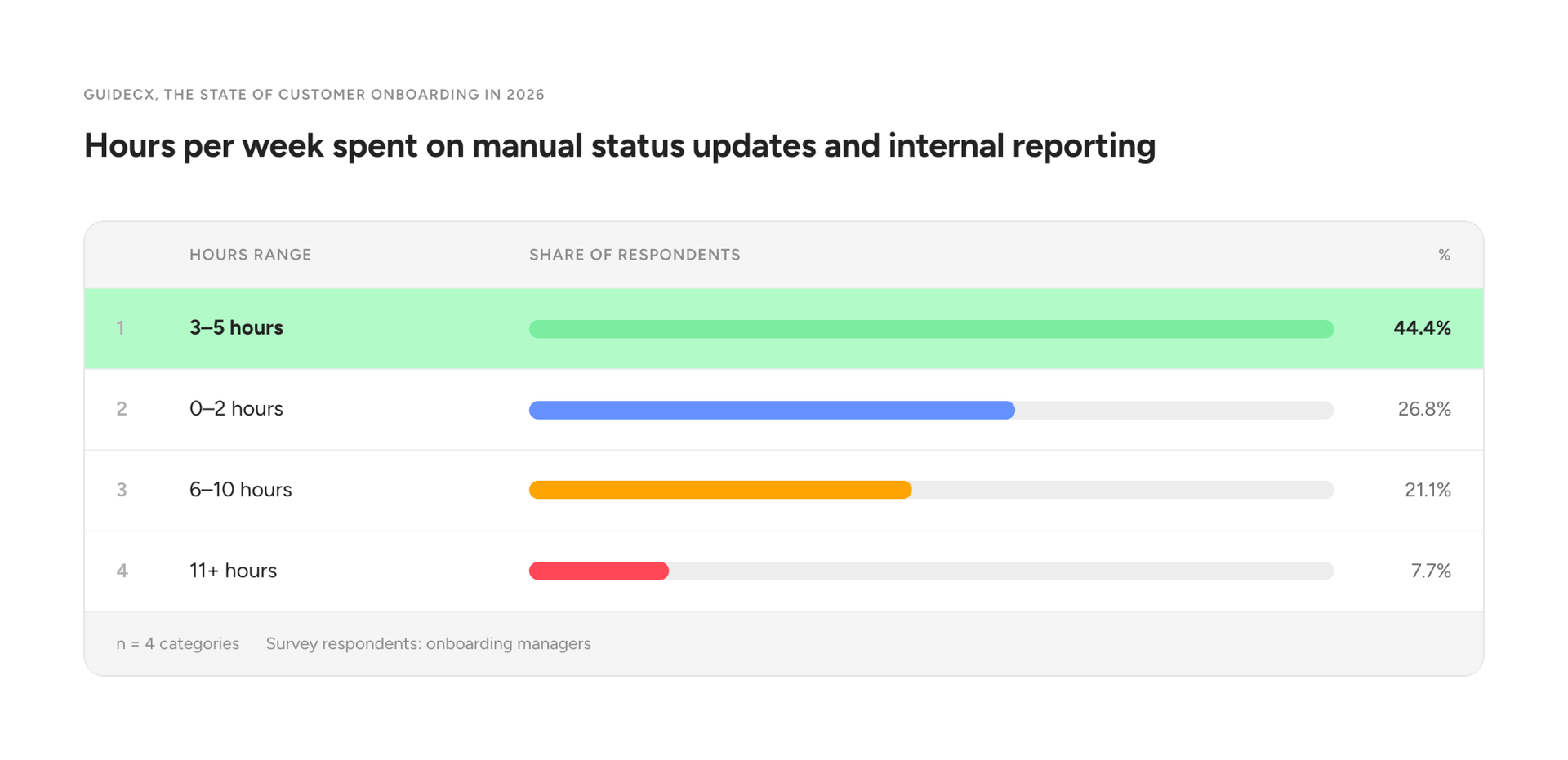
Teams could use that time. 72% of respondents spend at least three hours per week on manual status updates and internal reporting, while 28% spend more than six hours.
A due-date reminder can be automated. Understanding why a key stakeholder has stopped participating requires judgment. Implementation teams should spend their attention on the latter.
How can onboarding teams keep customer stakeholders engaged?
Visibility and ownership solve part of the problem, but engagement also depends on how much effort you require from customers to participate.
Your customer’s onboarding project may be one of your implementation team’s highest priorities. For the customer, it competes with their normal responsibilities and dozens of other priorities.
Our research found that 41.4% of customers struggle to stay engaged day to day, while another 29.3% struggle to complete required tasks. Every unnecessary login, confusing email thread, unclear deadline, or status meeting adds friction to a process that already demands several hours of the customer’s time each week.
Look at the experience from the stakeholder’s side. They should be able to quickly see what they owe your team, why the task matters, when it is due, what happens once they complete it, and how the overall implementation is progressing.
The easier that information is to find, the less coordination your implementation manager has to recreate through reminder emails, status calls, and one-off follow-ups.
What should onboarding leaders measure as stakeholder complexity grows?
As projects become more cross-functional, task completion alone doesn’t tell you whether stakeholder coordination is working.
Track how coordination affects time-to-value, completion rate, customer responsiveness, on-time completion, and customer satisfaction. In our research, 57.9% of teams formally track CSAT, 57.1% track time-to-completion, 50% track onboarding completion rate, and 47.1% track time-to-value.
Then examine what is driving those numbers. A pattern of projects stalling after security enters the process, for example, may indicate that security stakeholders are being identified too late. Faster completion among projects with clearly assigned customer owners could point to stronger accountability, while repeated follow-up around the same milestone may expose a task or dependency that needs to be redesigned.
Those patterns give onboarding leaders more actionable information than a portfolio-level average alone.
Better stakeholder management doesn’t mean fewer people
More stakeholders aren’t inherently a sign that your onboarding process has become too complicated. For complex B2B products, bringing the right people into the process is often necessary, and our data suggests broader customer participation can coexist with strong on-time completion.
What matters is how much work the implementation team has to do to keep everyone coordinated.
If implementation managers spend their days forwarding updates, tracking down task owners, rebuilding project status, and reminding people what they owe, every additional stakeholder creates more manual coordination. Clear responsibilities, shared visibility, and automated routine follow-up change that dynamic by making it easier for each person to understand what they need to do next. For onboarding leaders, the opportunity is to preserve the collaboration complex implementations require while reducing the work needed to coordinate it.
GUIDEcx is built around that idea. By bringing internal teams and customers into a shared onboarding workspace, automating routine engagement, and giving stakeholders visibility into the work that matters to them, teams can spend less time keeping everyone in sync and more time helping customers reach value.

- How to Manage Multiple Stakeholders During Customer Onboarding – September 22, 2026
- How to Track Project Health in Customer Onboarding – September 9, 2026
- Why Customers Churn During Onboarding, and How to Prevent It – August 25, 2026