


If you’re here, you probably have a decent idea of how to onboard a customer. But if you’re here, you probably also want to get better at it.
Whether you’re deeply familiar with customer onboarding already or you’re not, we have some guidance to share after learning from hundreds of thousands of completed onboarding projects on our platform. Let’s see if we can help you build a better model for onboarding new customers.
What is Customer Onboarding?
First things first. Let’s define Customer Onboarding. Or maybe even redefine it.
A common definition of Customer Onboarding is that it’s the process of getting new customers set up and using your product. Let’s call this Definition A. It’s not wrong, but a little incomplete.
That definition frames onboarding as a transitional phase between the sale and the rest of the customer relationship. It implies that the process is procedural and is simply about getting a customer from point A to point B.
Here’s a definition we think is more useful: customer onboarding is the deliberate process of guiding a new customer from the moment they commit to your product to the moment they realize its value. In other words, the moment they do use your product (not that they can use it), and it works, and they trust they made the right call. Let’s call this Definition B.
Notice the distinction? Definition A is purely operational. An onboarding motion aligned with that definition will be task-driven and focused on how the onboarding team runs its projects. Definition B is much more strategic. Teams with this POV will measure, automate, staff, and dictate their operations differently. Instead of a deep focus on their internal operations, they’ll build their onboarding with a greater emphasis on what their customers experience through their journey post-sale.
Ultimately, the distinction matters because of what your customer’s onboarding experience portends for the rest of their relationship with your company. If the experience is bad, your retention odds are at risk and may be unrecoverable.
Lincoln Murphy, the godfather of Customer Success (he literally wrote the book on it), explained this perfectly when he wrote “The Seeds of Churn are Planted Early.”
He says that 80-90% of customers who churn cite challenges they experienced very early in their lifecycle. Murphy places the blame on vendors and their onboarding process almost every time, putting it bluntly, “If you’re the vendor in this case, if you’re having onboarding issues, it’s your fault. You basically told the customer from the very beginning of the relationship that you don’t care about them. You don’t care if they’re successful.”
How Do You Onboard New Customers? Start with Principles, then Process
After supporting half a million customer onboarding projects (and counting) in GUIDEcx, we’ve learned a thing or two about what a good onboarding model looks like. To make your model more strategic and built towards creating trust with your customers, we’ve outlined 3 principles that we think are important. Then, we’ll dig into the process.
Principle One: Onboarding Is Part of the Product
There’s a concept in psychology called the primacy effect: the first experience in a sequence is disproportionately durable in memory. In the customer lifecycle, onboarding is that first experience. Importantly, you don’t get to make that first impression twice.
Your customer’s experience of your product begins during onboarding. Every email they receive (or don’t receive), every roadblock they experience (or don’t), and every feeling they have during onboarding has an outsized impact on how that customer perceives your company, your product, and the decision they just made.
Here’s what we see happen when teams don’t think this way: the onboarding experience feels disjointed, reactive, and chaotic. That impression sticks and follows every interaction with your company afterward.
So what does it look like to treat onboarding as a product? We wrote about it at length here.
In sum, it means applying the same design rigor to onboarding as you give your actual product. In practice, it means creating an onboarding model that is deeply intentional about ensuring your customers can engage how they like to engage, is transparent to all parties involved, and that customers feel cared for.
Principle Two: Human at the Core, Technology at the Edges
We’re seeing more and more onboarding teams eager to layer as much automation and AI into their operations as they can. The temptation makes sense; AI has never been more capable. But we feel strongly that customer onboarding should be an innately human experience at its core.
Let’s be clear: we love AI and we love automation. The routine, mechanical parts of onboarding (task reminders, status updates, project creation from CRM triggers, resource provisioning, risk management, forecasting, etc.) are genuinely better when a system handles them. We’ve built those features into our product and have invested heavily in our back-end infrastructure to ensure it’s uniquely capable of enabling AI innovation. Our customers find a lot of value in these solutions and are using them to drastically improve their onboarding models.
But the work that actually determines whether a customer gets value in their onboarding is still irreducibly human. And we think it always will be.
Here’s where humans are uniquely suited to do something that AI or automation can’t:
- The PM who reads the room on a kickoff call and realizes the VP who bought the product isn’t the person who’s going to implement it (and that person is skeptical).
- The onboarding lead who notices a customer’s engagement shifting from enthusiastic to politely distant and picks up the phone before it becomes a real problem.
- The CSM who knows when to push a stalling customer and when to give them space, because the real blocker is internal politics they haven’t communicated yet.
No automation handles those nuanced, instinctual situations. No AI agent reads that room. Not well enough, anyway.
The model we believe in is human-in-the-loop. With this approach, technology handles the mechanics so your people have the capacity to do the work that requires judgment, empathy, and expertise.
One example of how we’ve built this philosophy into GUIDEcx is our recently launched RAG Agentic Coach. It’s an AI agent that proactively reviews your onboarding project portfolio, identifies risks through patterns in real-time data, surfaces those risks, assigns a risk score (Red, Amber, Green) to each project, then coaches your team through mitigation steps.
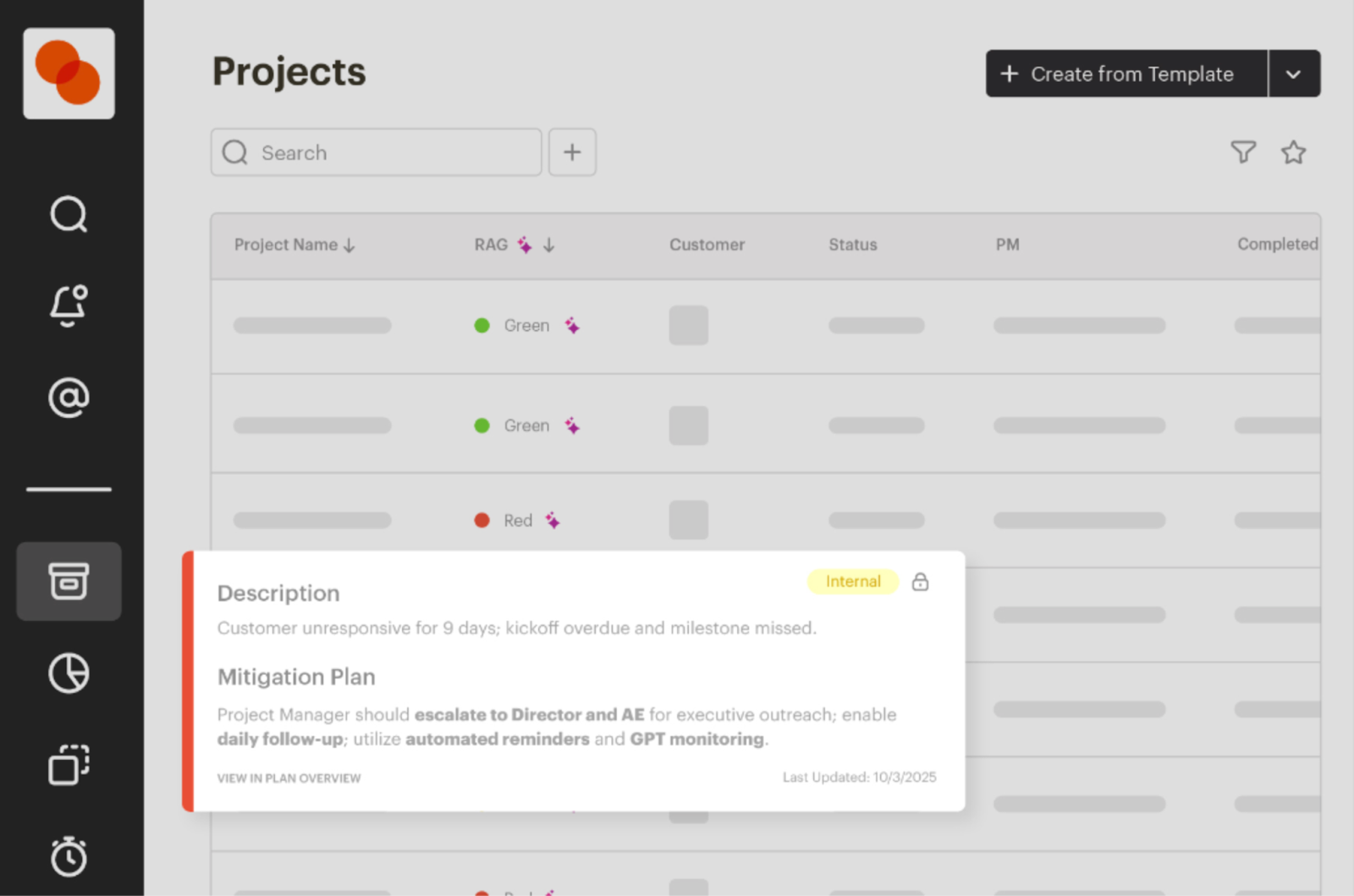
In other words, the agent finds the risk and serves as a coach. A person is responsible for intervening.
Getting this balance right is tricky, but if the teams that do are going to simultaneously improve their efficiency, and their retention.
Principle Three: Make Customer Onboarding Customer-Facing
Making customer onboarding customer-facing sounds intuitive, but customers lacking visibility into their project status is such a pervasive challenge facing onboarding teams that it’s clearly not the norm. Teams are struggling to provide an external-facing experience because they’re using tools designed for internal workflows.
We see the majority of B2B companies we talk to running onboarding on internal tools like spreadsheets, traditional project management tools (think Asana), and email. Best case scenario, their onboarding team has a detailed, real-time view of where things stand, but their customer has almost none.
Now think about what that asymmetry actually produces from the customer’s perspective. They don’t really know what’s been completed, what’s in progress, what they’re supposed to be doing, and how long until they can expect to go live. In practice, they tend to shoot emails to your team (or their sales rep) asking about their project’s status, and they begin to feel like they’re on the outside of a process built for them.
Customer-facing onboarding inverts that assymetry. We think it’s so important that we’ve built our whole product around it. And we took inspiration from the Domino’s Pizza Tracker.
In GUIDEcx, the end-user (your customer) gets a dedicated workspace, white-labeled with our customers’ branding, where they can see their project timeline, their assigned tasks, their onboarding team’s tasks, and overall progress. They get notified when something needs their attention and can complete it on their own schedule.
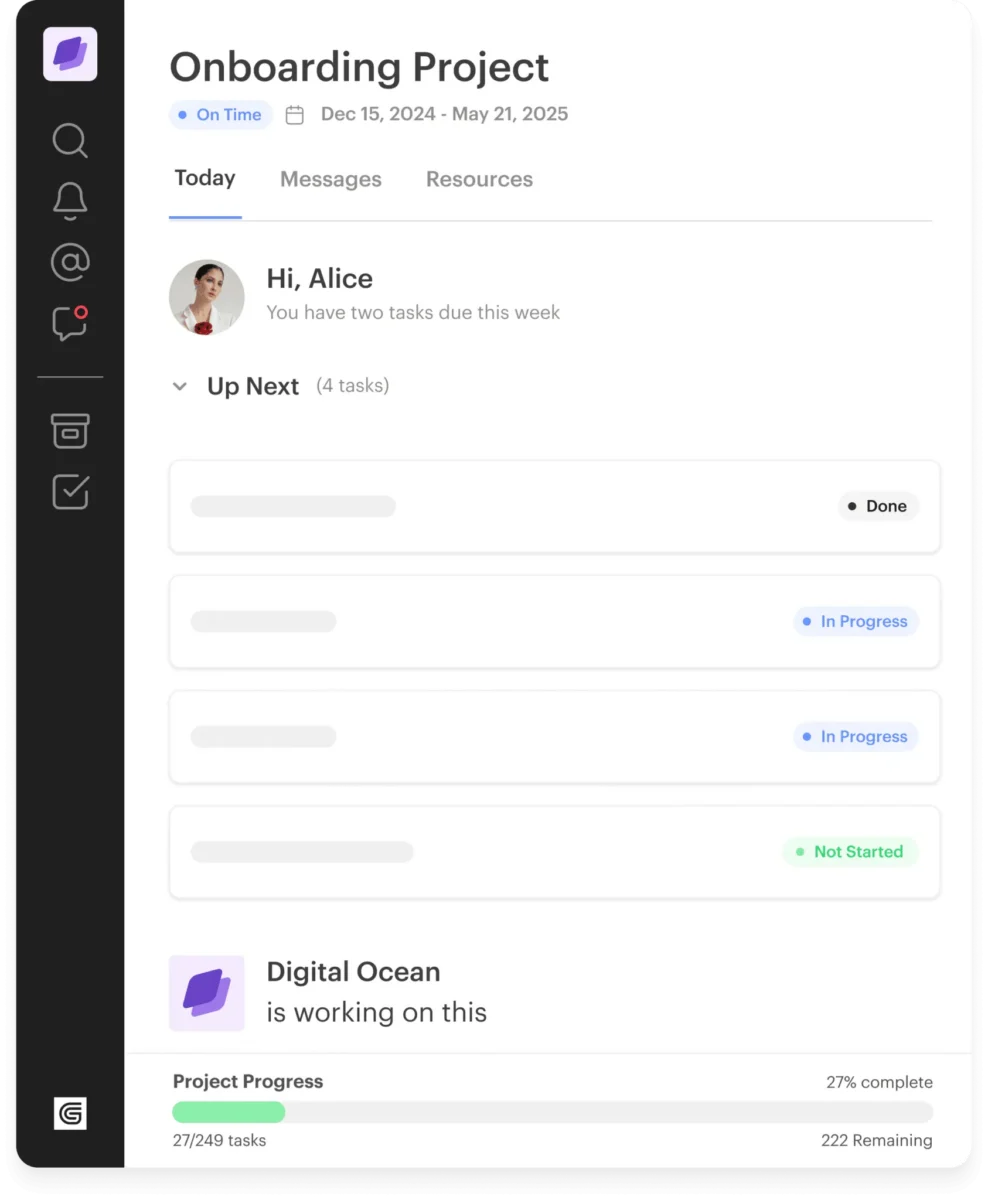
Being able to complete tasks on their own schedule is important. Data from our users shows that over 80% of customer tasks get completed outside of standard business hours.
When customers have clear visibility into their onboarding, accountability distributes itself naturally. The conversations your team has with customers shift from “where are we?” to “what’s next?” That single shift is worth redesigning your entire process around.
How to Improve Your Customer Onboarding Process
If the principles above describe where you want to end up, below are some practical places to start.
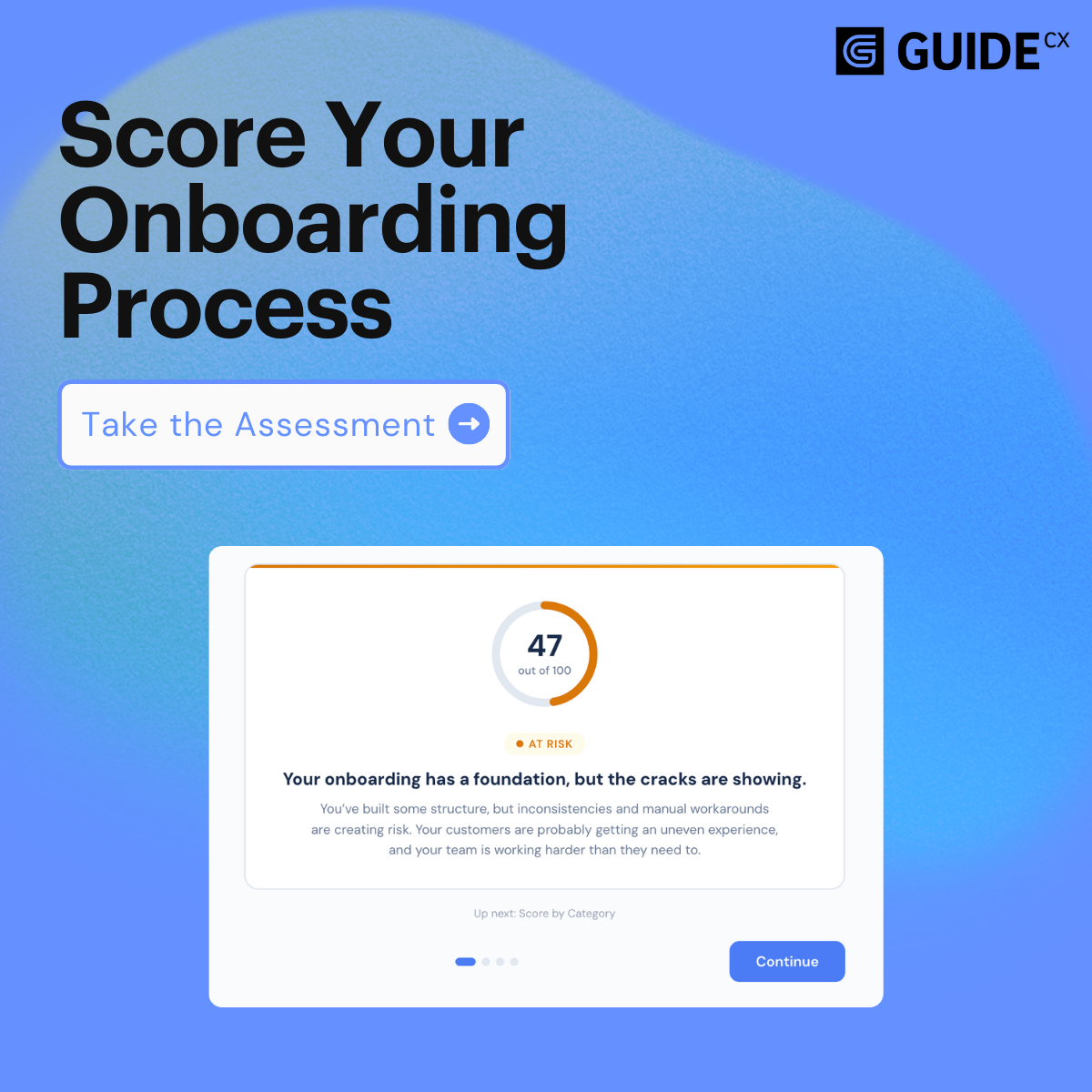
But we’d also recommend trying our free tool in which you can grade the effectiveness of your customer onboarding. It takes two minutes.
- Walk the customer journey yourself. Before you optimize anything, experience your own onboarding process from the customer’s side. Read every email they’d receive. Try to figure out what you’re supposed to do and when. Navigate whatever tools you’re asking them to use. If you get confused or frustrated at any point, your customers do too. Sounds like a basic exercise, but you’d be surprised what you find.
- Run discovery again, but for implementation. The people who bought your product are often not the people who will implement it. Their priorities and how they define success are probably different. Before you build the plan, invest the time to understand what success looks like for the people who will live with your product every day.
- Give the customer a window into the process. If your customer can’t see where they stand in onboarding without emailing your team, that’s a visibility problem worth solving. Whether it’s a purpose-built onboarding platform or a customer-facing layer on top of your current tools, the investment pays for itself in reduced manual communication and increased trust.
- Design for asynchronous engagement. Your onboarding process is not your customer’s full-time job. It’s something they fit between meetings, after hours, on weekends. If every milestone requires a synchronous interaction, you’re throttling progress to calendar availability. Build in self-serve task completion with clear guidance. Let customers move things forward on their own time. This is a structural advantage.
- Connect onboarding data to retention outcomes. Want to change how leadership views onboarding as a function? Until you can draw a clear line from onboarding quality to 12-month retention, onboarding will be undervalued and underfunded. Build metrics for this; we recommend time-to-value as a core KPI.
The ROI of Good Customer Onboarding
If you’ve read this far, you’re probably already thinking about which of these principles your current process violates and what it would take to close the gap. Awesome! Follow that instinct.
Onboarding done well is the highest-leverage investment a B2B company can make in customer retention. The companies that design onboarding as a customer-facing, human-centered product experience are building a compounding advantage. If you want to turn this into a reality for your team, give us a shout.

- How to Onboard a Customer – April 9, 2026
- Our CTO, Alex Nelson, on Coffee With Calyptus – March 31, 2026
- Why You Can’t Vibe Code a Customer Onboarding Solution – March 31, 2026