


There is no shortage of investment in the customer lifecycle before and after onboarding. The teams responsible for acquiring customers are well-resourced with headcount and platforms that have been optimized for decades to streamline their work. Customer Success teams are similarly resourced, with teams that scale as new customers are acquired and software that’s geared toward retaining and expanding the clients they oversee.
What do onboarding and implementation teams have? Historically, not a lot. Just see the breakdown below.
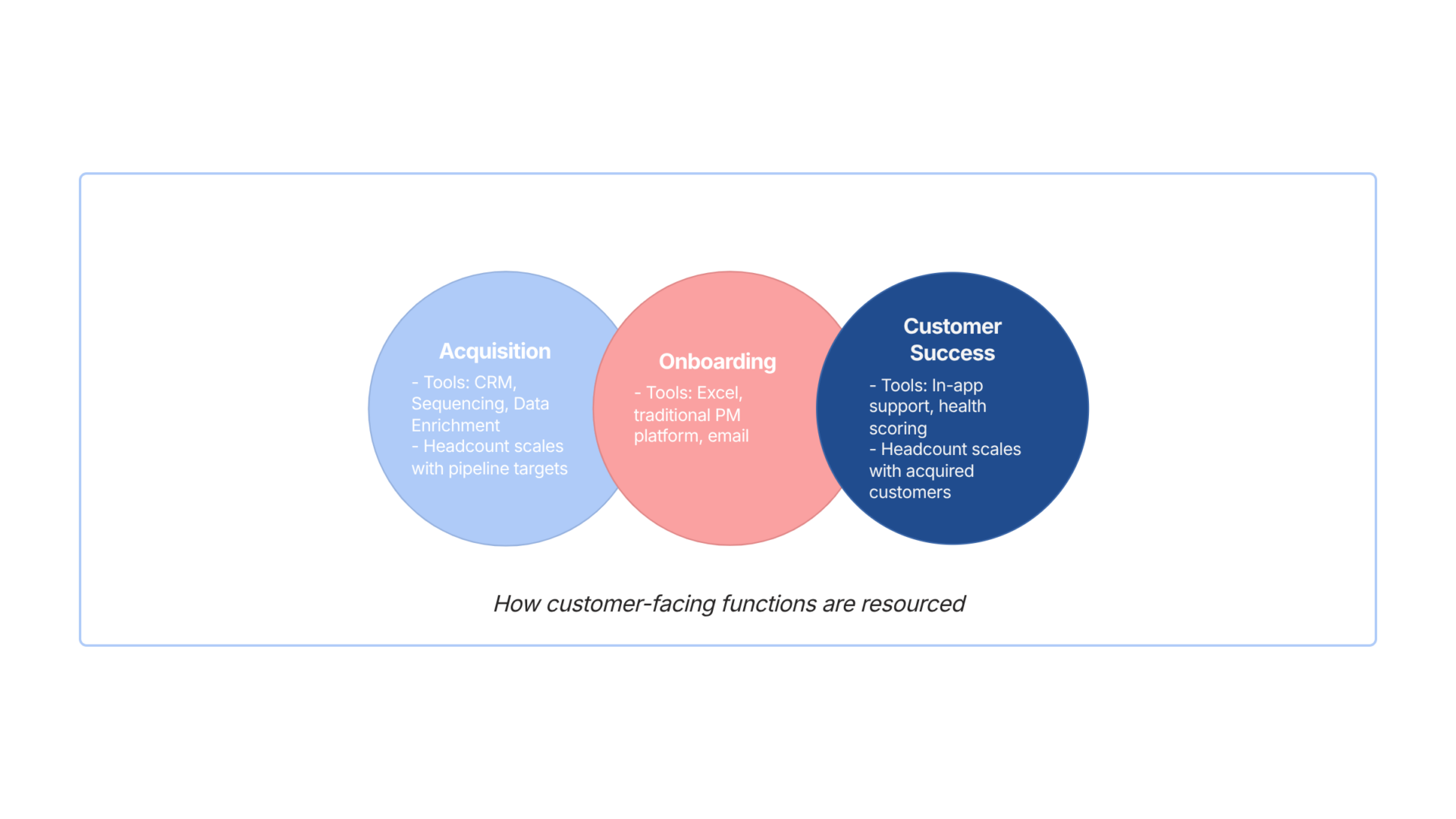
After analyzing our conversations with hundreds of onboarding teams in the last year, it’s become clear that their function is severely under-resourced. Ironically, the phase of the customer lifecycle they oversee also includes the highest-leverage moments for influencing retention and revenue through the course of the relationship.
In this article, we’ll dig into the patterns we’ve seen that indicate onboarding is under-invested in and why the ROI case for investing more into it is so strong.
What the Data Says About the Challenges of Customer Onboarding
We’ve documented the challenges customer onboarding teams faced in the last year. After running the data, 7 specific pain points surfaced to the top.
Here’s the breakdown:
Customer Onboarding Teams Universally Struggle With Project Transparency
Our biggest finding was that every single team we spoke with described some version of the same problem: they don’t have a clear, real-time view of where their active onboarding projects actually stand. Not their project managers. Not their leaders. And especially not the customers living inside the process.
It’s a fundamental problem with how B2B organizations have historically delivered their software and services. And strangely enough, it’s an area in which B2C companies have innovated for their customers for decades now, despite the steep contrast between B2B and B2C purchase sizes.
Think about it: when you order a package, or better yet a pizza, you know exactly where that product is from, from when you ordered it to when it’s in your hand. Shipping companies have made this a near non-negotiable experience, and Domino’s was the first mover for pizza delivery chains with its Pizza Tracker, where you can even know when it’s in the oven.
B2B customers should expect the same level of transparency in their onboarding and implementation. Much like knowing that your pizza is 3 miles away from your house, you should know you’re 5 days away from a successful go-live.
But the data tells us that onboarding teams are consistently unable to provide this transparency for their customers, or even themselves. That’s because they rely on tooling that isn’t capable of it—spreadsheets, traditional project management software, and emails—rather than a purpose-built SaaS onboarding platform.
We see this same principle show up across every onboarding challenge you see above. The teams we speak to are forced to run their operations with inadequate resources, and it culminates in the challenges they feel every day. That’s why they’re turning to customer onboarding software like GUIDEcx to help.
The Cost Shows up Downstream, and by Then It’s Too Late
The reason this matters beyond operational frustration is that the onboarding window is when customer confidence is won or lost. Sixty-four percent of the teams we spoke with had directly connected poor onboarding to early churn—customers leaving before they ever reached a meaningful outcome with the product.
There’s a term for this: inception churn. One leader we spoke with called it their single biggest and most controllable challenge. Controllable is the key word there. This isn’t churn driven by product failure or competitive loss. It’s churn that happens because the handoff from sales to implementation was disorganized, the customer lost momentum, and nobody had the visibility to intervene before it was too late.
That’s an expensive problem to ignore, and many companies are ignoring it by default, not by design.
What Well-resourced Onboarding Actually Looks Like
The teams pulling ahead on this aren’t doing anything exotic. They’ve made a few deliberate investments that compound quickly: structured, repeatable project management workflows so nothing gets rebuilt from scratch, a shared view of project status that eliminates the guesswork, and automated engagement that moves the burden of follow-up off their people and onto the process.
The output is faster time to value, lower inception churn, and an onboarding motion that can actually scale without a proportional headcount increase.
None of that is complicated in theory. The gap between knowing it and doing it is almost always a resourcing decision, and there are plenty of tools on the market to support it.
The companies making that decision now are going to have a real structural advantage over the ones that wait for the problem to get loud enough to force it.

- How to Use MCP with the GUIDEcx API for AI-Powered Customer Onboarding – September 4, 2026
- How to Reduce Manual Work in Customer Onboarding – August 31, 2026
- Introducing the State of Customer Onboarding in 2026: All New Report – August 17, 2026