

The customer onboarding software category is getting big. By our count, there are now over 40 vendors competing for your attention. At first glance, a lot of them look the same, with similar landing pages, similar G2 reviews, and similar promises about reducing time-to-value. It’s genuinely hard to know where to start.
But the confusion mostly goes away once you understand one thing: many of the tools aren’t really competing with each other. The market has naturally organized itself into three distinct buckets, and each bucket is solving a fundamentally different problem.
So, if you get the category right first, selecting a vendor gets a lot easier after that.
Here’s our view of the market landscape. We hope it helps you find your way.
The 3 Categories of Customer Onboarding Software
1. Digital Adoption Platforms
These primarily help users learn the software while they’re already inside it. They tend to include features like tooltips, interactive walkthroughs, and in-app checklists to help users get started quickly. The orientation is toward the end user, and the approach to onboarding is largely hands-off. Think Pendo, WalkMe, and Appcues.
2. Customer Onboarding Platforms
Built for implementations that are high-touch and have real layers of complexity. Buyers in this bucket tend to need transparent progress in projects, intelligent forecasting, and tight communication between your team and your customer’s team. Think GUIDEcx, Rocketlane, and OnRamp.
3. Customer Success Platforms
These platforms are dedicated to retaining and expanding customers after the sale. They typically have some onboarding capability, but it’s not the core focus. Their real value is in health scoring, renewal management, and expansion plays. Think Gainsight, Totango, and ChurnZero.
These three categories share a general neighborhood (they all live somewhere in the post-sale journey) but they’re solving different things for different teams with different motions. To ensure you’re making the right decisions in your evaluation, make sure to orient yourself here first.
So Which One Do You Actually Need?
A few signals tend to point clearly in one direction or another.
Digital Adoption Platforms are fundamentally about PLG. If your product is relatively low-cost, subscription-based, and your users can largely find their way given the right in-product nudges, these tools are for you. The implementation is light, the users self-serve, and success looks like activation at scale.
Customer Onboarding Platforms are for when self-service isn’t an option. If your onboarding process takes weeks or months (and especially if it’s inconsistent), involves multiple stakeholders on both sides, and requires configurations and integrations to actually complete, you need a tool built for that kind of collaboration and accountability. These platforms give your CS or implementation team a shared workspace with your customer, with visibility into who owns what and what’s blocking progress.
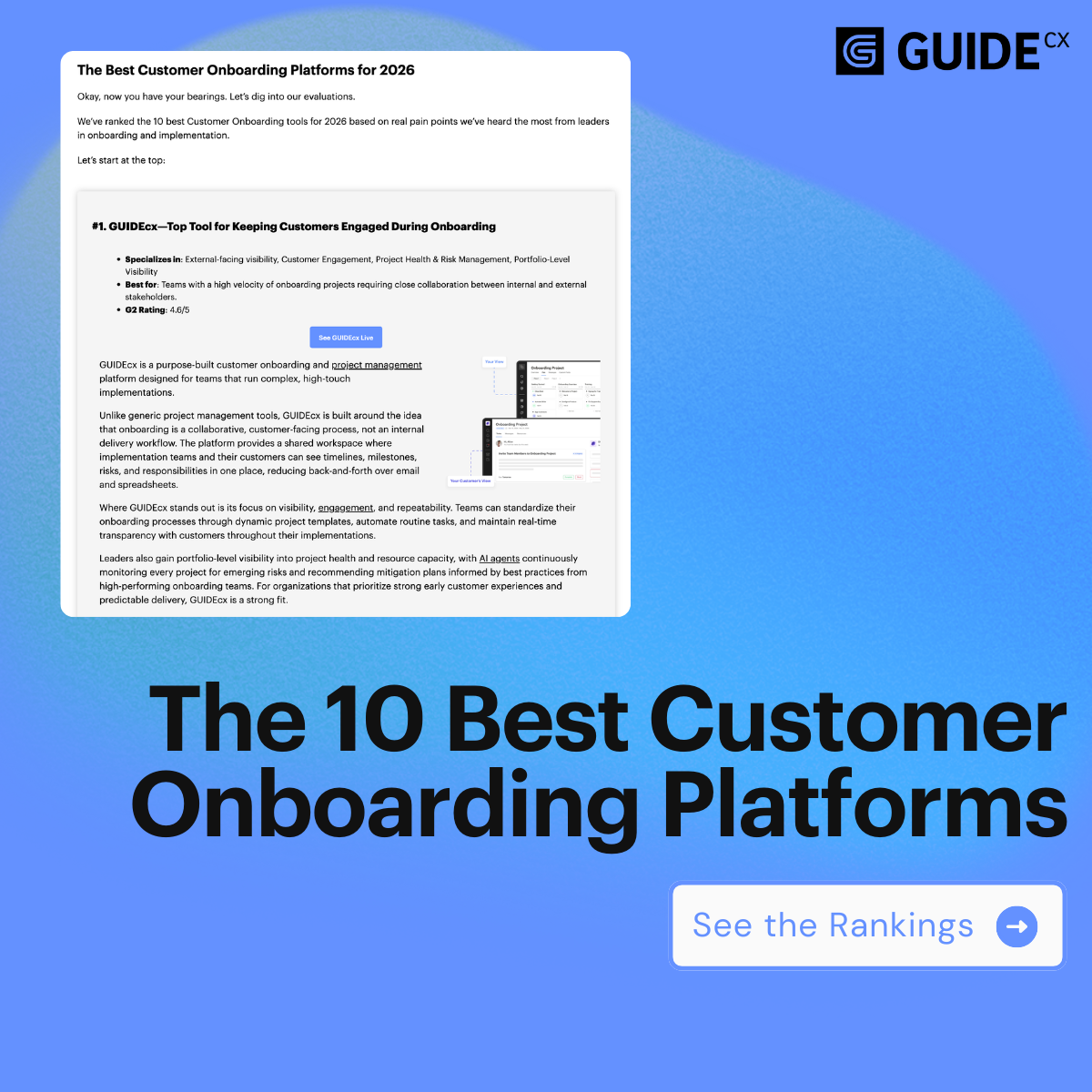
We Ranked the 10 Best Customer Onboarding Software
If you’re looking for a Customer Onboarding Platform, start here.
Customer Success Platforms are playing a longer game. If your primary concern is what happens 6–12 months after the sale—churn risk, expansion signals, renewal health—that’s where CSPs shine. Many of them have onboarding features, but they’re usually not deep enough to run a high-touch implementation on their own.
If you’re still not sure where to start, the tool below should help. Answer four quick questions about your product and your team’s motion, and it’ll provide a customer recommendation just for you.
A Note on Overlap
The categories aren’t perfectly clean. Some Customer Success Platforms have added onboarding modules. Some Customer Onboarding Platforms are building out post-live health features. A handful of Digital Adoption Platforms have started layering in more CS-adjacent capabilities.
That’s to be expected; software categories tend to blur at the edges. But the core value of each tool still points in a distinct direction, and that’s what should drive your evaluation. Start with the job to be done, then match it to a category, then go look at vendors.
Doing it the other way around is how you end up with a tool your team doesn’t actually use.

- How to Onboard a Customer – April 9, 2026
- Our CTO, Alex Nelson, on Coffee With Calyptus – March 31, 2026
- Why You Can’t Vibe Code a Customer Onboarding Solution – March 31, 2026