

The conversation around AI in business often sounds like science fiction—robots taking over jobs, fully automated processes, and dystopian workplace futures. But what if we told you the real AI revolution in customer onboarding is happening quietly, practically, and with surprisingly human results?
At GUIDEcx, we’ve moved past the theoretical discussions about AI’s potential to focus on its actual impact. Our Professional Services team, led by Mark Mitchell, has spent the last year building and testing AI-powered solutions that don’t just automate tasks—they amplify human expertise and create better customer experiences.
Here’s what we’ve learned about implementing AI in customer onboarding, and why the future might be more collaborative than you think.
The Foundation: Think Training, Not Magic
The biggest misconception about AI in project management is that it works like magic—you flip a switch and suddenly everything is automated. The reality is far more practical: AI agents need training, just like human employees.
Every effective AI implementation we’ve built follows two core principles:
Instructions (The Governance): These are your kitchen rules and recipes. They define what the agent should and shouldn’t do, establishing the boundaries that ensure consistency with your company’s standards and voice.
Knowledge (The Context): This is your pantry of tribal knowledge, best practices, and company-specific information that gives the agent the context it needs to provide accurate, relevant responses.
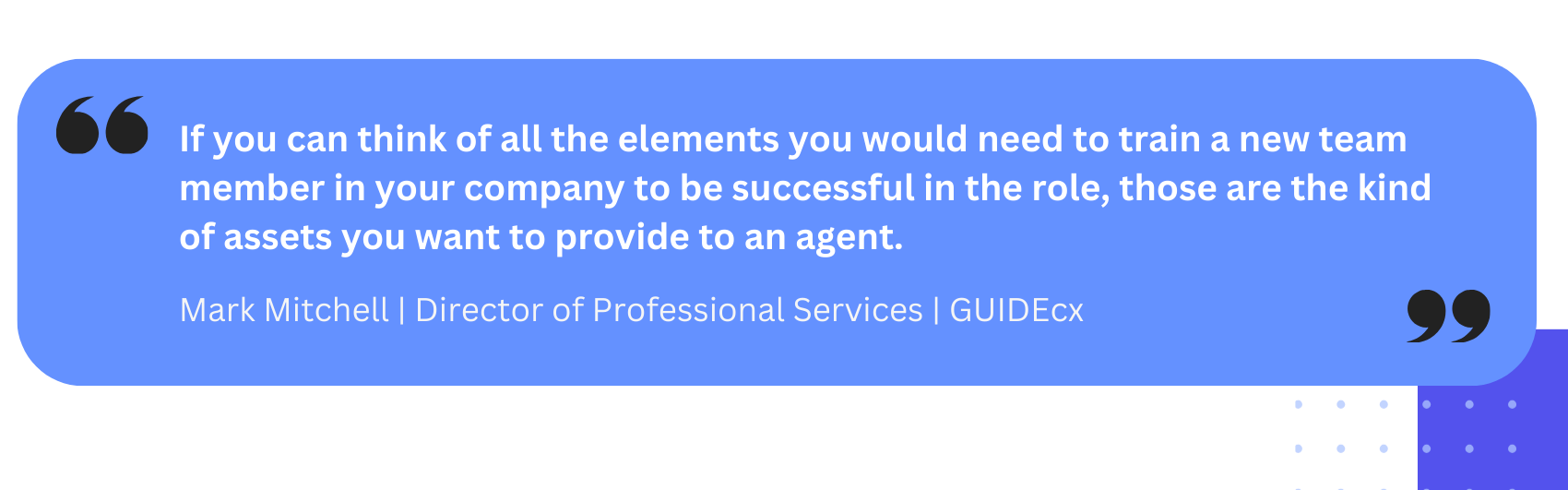
Think of it like training a new team member. You wouldn’t throw someone into a customer-facing role without proper onboarding, documentation, and clear expectations. The same principle applies to AI agents.
Real-World Application #1: The Deal Summarizer
Sales-to-delivery handoffs are notoriously challenging. Despite best intentions, critical information gets lost in translation, leaving project teams scrambling to fill knowledge gaps during kickoff calls.
Our Deal Summarizer agent acts as a safety net, analyzing sales call transcripts, emails, and AE notes to extract key information that might otherwise slip through the cracks. It doesn’t replace the human handoff conversation—it augments it.
The impact: Teams show up to kickoff calls with confidence, able to confirm what they already know rather than conducting net-new discovery. Customers feel heard because their specific timelines, goals, and concerns are already understood.
Key questions our Deal Summarizer answers:
- What potential risks or challenges were identified?
- What are the customer’s primary goals and success metrics?
- What integrations or technical requirements were discussed?
- Are there any aggressive timelines or critical milestones?
- Who are the key stakeholders and decision-makers?
Real-World Application #2: The SOW Generator
The scoping call is where professional services engagements are won or lost. Customers need clear deliverables, timelines, and expectations—but translating a complex discovery conversation into a comprehensive Statement of Work (SOW) traditionally required hours of post-call work.
Our SOW Generator transforms this process. Team members can stay fully present during scoping calls, engaging authentically with customers without the distraction of detailed note-taking. The AI analyzes the transcript and produces a ready-to-send SOW document.
The built-in quality control: If critical information is missing from the conversation, the agent flags exactly what additional details are needed before generating the SOW. This prevents incomplete or inaccurate project scopes.
Customer experience impact: Faster turnaround times between scoping calls and project initiation, with more accurate project definitions that set clear expectations from day one.
Real-World Application #3: Project Health Monitoring (RAG Status)
Project managers excel at perfecting processes and helping customers succeed. What’s harder is consistently identifying when projects are veering off course and knowing exactly how to respond.
Our RAG Status agent continuously monitors project data—messages, timelines, task completion rates, and stakeholder engagement—to provide an unbiased health assessment for every active project.
The Disney principle: Like Disney employees who are trained to turn problems into magical moments, this system helps teams proactively address issues before customers even realize there’s a problem.
How it works:
- Projects that age beyond 60 days automatically trigger monitoring
- The system applies red/amber/green status based on predetermined criteria
- Each status comes with a specific mitigation plan based on company SOPs
- Results feed into executive reporting for leadership visibility
Real example: A customer went dark for a week during implementation. The system flagged the risk, provided specific re-engagement steps based on our protocols, and the team member followed the recommended mitigation plan. The customer re-engaged, and the project launched successfully.
The Personalization Question: Quality vs. Origin
One of the most frequent questions we encounter is: “How do you maintain personalization at scale?”
Here’s our perspective: customers care more about getting accurate, timely, helpful responses than they do about whether AI was involved in crafting those responses. The shame around using AI—what we jokingly call “AI shame”—often prevents teams from delivering better customer experiences.
Our approach: Always start with human expertise, then use AI to refine, polish, and ensure consistency. The core insight, analysis, and strategy remain human-driven. AI helps with clarity, completeness, and speed of delivery.
Real-World Application #3: Project Health Monitoring (RAG Status)
For teams considering AI implementation, here are our key recommendations:
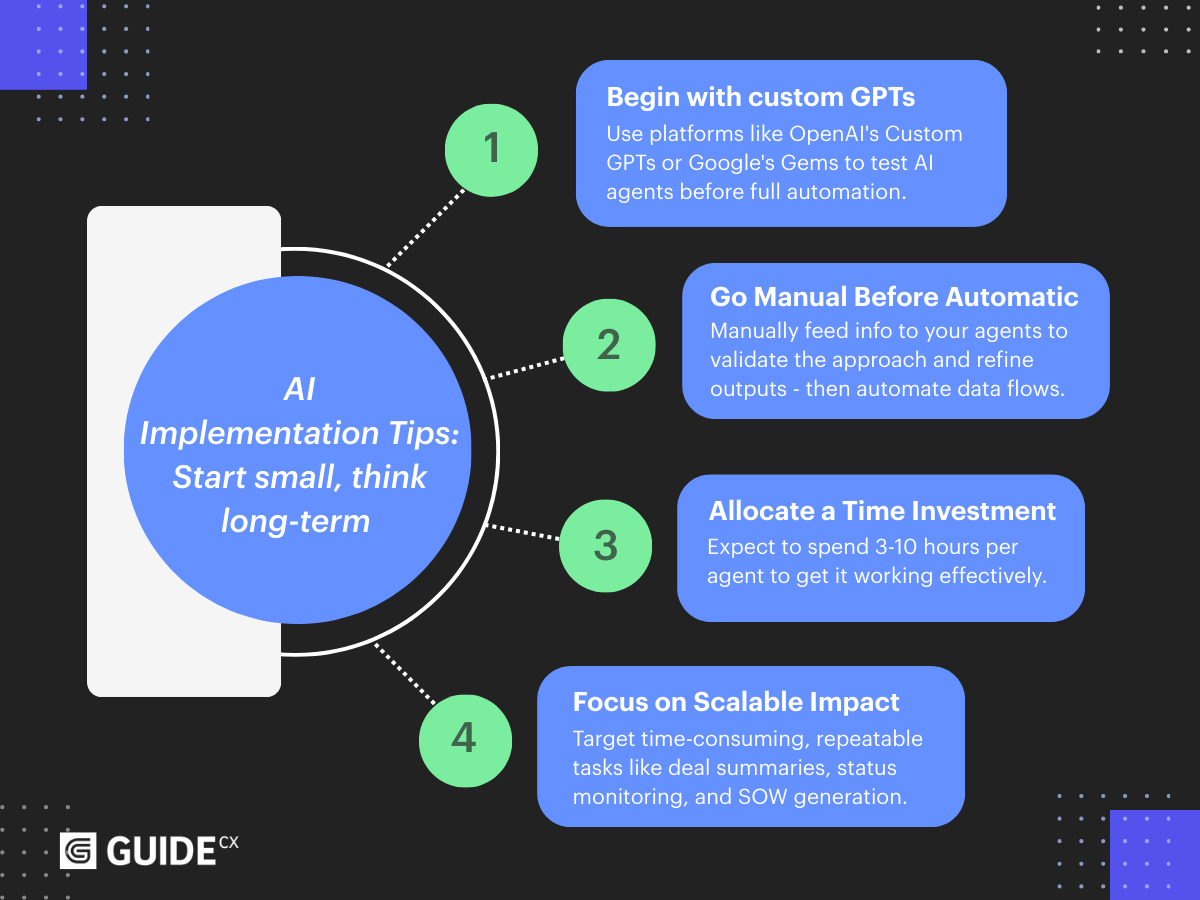
Begin with custom GPTs: Platforms like OpenAI’s Custom GPTs or Google’s Gems provide an accessible entry point for testing AI agents before investing in full automation.
Manual before automatic: Start by manually feeding information to your agents. Once you’ve validated the approach and refined the outputs, then automate the data flows.
Time investment: Expect 3-10 hours of focused work per agent to get it operating effectively. The collaborative nature of modern AI tools makes this process much more efficient than traditional automation.
Focus on high-impact, repeatable processes: Deal summaries, SOW generation, and status monitoring are ideal starting points because they’re both time-intensive and follow predictable patterns.
The Future of AI-Augmented Teams
The companies that will thrive in the AI era aren’t those that replace humans with machines—they’re the ones that figure out how to combine human expertise with AI capabilities to deliver exceptional results.
As Mark Mitchell puts it: “Companies who don’t figure out how to go from helping people do work to just doing the work are going to be more at risk than others who are figuring out how to just do the work.”
This isn’t about elimination; it’s about elevation. AI handles the routine analysis, documentation, and monitoring tasks that consume valuable time, freeing human experts to focus on strategy, relationship-building, and complex problem-solving.
Your Next Steps
Whether you’re leading customer success, professional services, or project management teams, the AI opportunity isn’t in the distant future—it’s available today. Start with one process that’s both time-intensive and repeatable. Build your agent’s knowledge base just like you’d train a new employee. Test, refine, and iterate.
The goal isn’t to build the most sophisticated AI system. It’s to create tools that make your team more effective and your customers more successful.
The AI revolution in customer onboarding isn’t coming—it’s already here. The question is: will you be leading it or catching up to it?
Ready to explore AI-powered solutions for your customer onboarding processes? Connect with our team to learn how GuideCX can help you build more efficient, effective project management workflows.

- How to Use MCP with the GUIDEcx API for AI-Powered Customer Onboarding – September 4, 2026
- How to Reduce Manual Work in Customer Onboarding – August 31, 2026
- Introducing the State of Customer Onboarding in 2026: All New Report – August 17, 2026